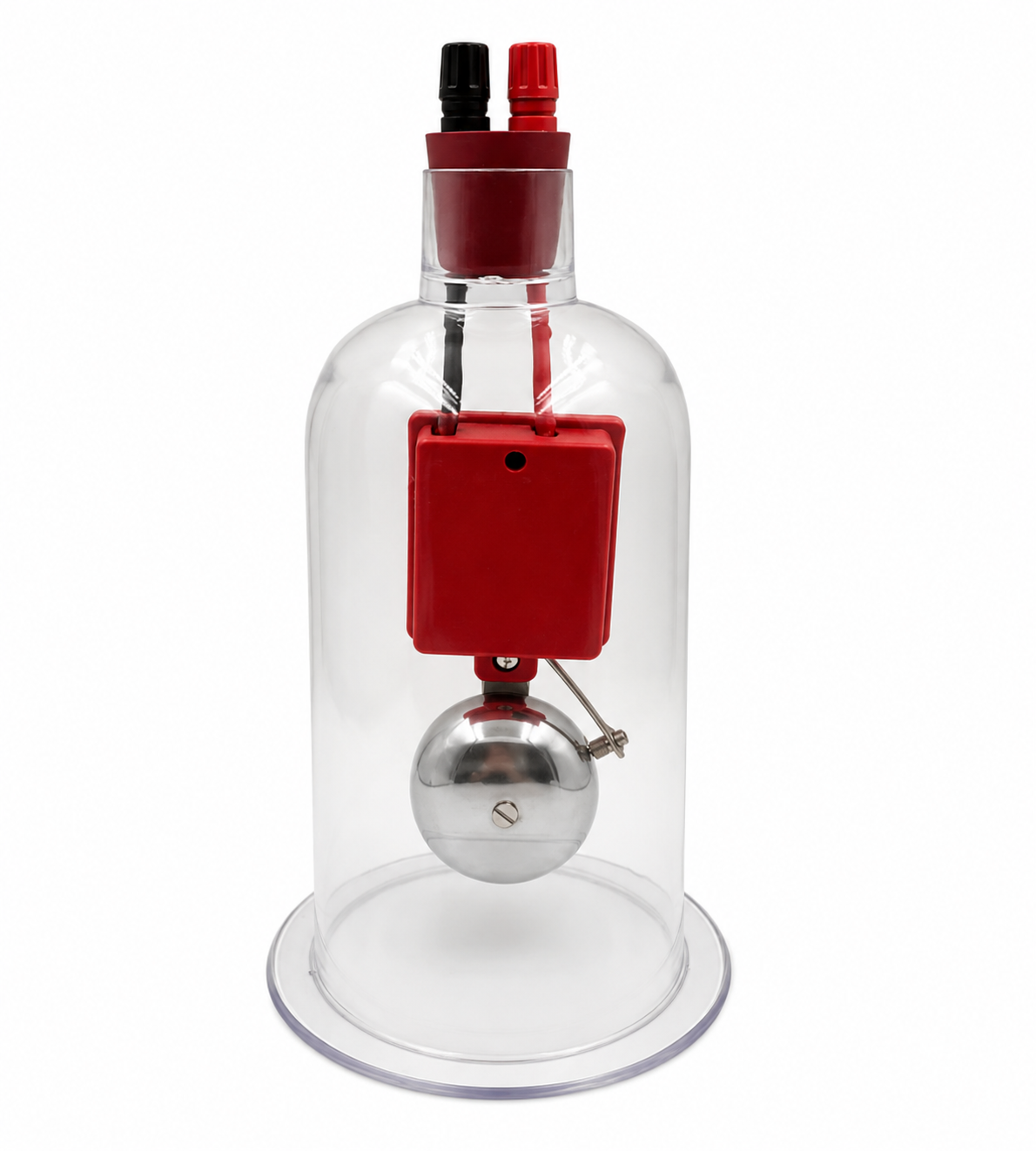
Bell in Jar with Air Pump – Demonstration That Sound Requires a Material Medium
Elmo Agencies, a trusted scientific manufacturer in Ambala, presents the Bell in Jar Experiment, a classic physics demonstration designed to show how sound propagation depends on the presence of a material medium.
The apparatus typically consists of an electric bell placed inside a transparent bell jar connected to a vacuum pump. When the bell operates while air is present inside the jar, its sound can be heard outside. As air is gradually removed from the jar, the sound becomes progressively weaker. This demonstrates that sound requires particles in a material medium, such as air, to transmit vibrations.
A bell is placed inside a sealed transparent chamber. The chamber is connected to a vacuum pump that gradually removes air from inside the jar.
The experiment allows students to observe two important effects:
- The bell can still be seen operating.
- The sound heard outside the jar becomes weaker as the amount of air inside decreases.
This provides direct visual and audible evidence that sound does not travel through an ideal vacuum.
How Does the Experiment Work?
Sound is a mechanical wave. In air, sound is transmitted through vibrations and collisions between air molecules.
When the bell operates:
- The bell vibrates and produces mechanical disturbances in the surrounding air.
- Nearby air molecules vibrate.
- These vibrations are transferred from molecule to molecule.
- The sound wave eventually reaches the wall of the jar and the surrounding environment.
- The vibrations are detected by the listener as sound.
When air is removed from the jar, the number of air molecules available to transmit these vibrations decreases.
As a result, the sound heard from the bell becomes weaker.
At sufficiently low pressure, very little sound is transmitted through the remaining gas.
It is important to note that a classroom vacuum pump usually does not produce a perfect vacuum. Therefore, some sound or vibration may still be detectable depending on the apparatus and experimental conditions.
What Does the Experiment Demonstrate?
Sound Requires a Material Medium
Sound cannot propagate through an ideal vacuum because there are no particles available to transfer mechanical vibrations.
Sound Is a Mechanical Wave
Unlike electromagnetic waves such as light, sound depends on the motion and interaction of particles in a material medium.
Effect of Air Pressure on Sound Transmission
As air pressure inside the jar decreases, fewer gas molecules are available to transmit the vibrations produced by the bell.
Difference Between Sound and Light
During the experiment, students can usually continue to see the bell operating even when its sound becomes very weak.
This helps demonstrate an important difference:
- Light can travel through a vacuum.
- Sound cannot travel through an ideal vacuum.
Why Does the Bell Become Quieter?
In Bell in Jar Experiment, the bell itself continues to vibrate and produce mechanical motion.
However, the surrounding gas inside the jar becomes less dense as air is removed.
With fewer air molecules available, sound transmission through the gas becomes less effective.
The reduction in sound heard outside the jar therefore occurs because the path for transmitting mechanical vibrations through the air is progressively reduced.
The bell does not necessarily stop vibrating when the sound becomes difficult to hear.
Educational Concepts Demonstrated
The Bell in Jar Experiment can be used to teach:
- Sound waves
- Mechanical waves
- Wave propagation
- Transmission of vibrations
- The role of a medium in sound transmission
- Air pressure and gas density
- Vacuum and low-pressure environments
- Differences between mechanical and electromagnetic waves
Typical Apparatus Components
Depending on the model and configuration, the Bell in Jar Experiment may include:
- Transparent bell jar or vacuum chamber
- Electric bell or buzzer
- Electrical connection for operating the bell
- Vacuum plate or base
- Vacuum connection
- Vacuum pump connection or compatible pump
- Tubing and valves, where applicable
The exact components, dimensions and vacuum pump configuration may vary according to the specific model supplied.
Classroom Demonstration Procedure
A typical demonstration can be performed as follows:
- Place the bell inside the transparent jar.
- Operate the bell while the jar contains air.
- Allow students to observe and hear the bell.
- Begin removing air using the connected vacuum pump.
- Observe the gradual reduction in the sound heard outside the jar.
- Continue to observe the bell’s visible operation.
- Allow air back into the chamber and observe the sound becoming louder again.
The experiment should always be conducted according to the operating instructions supplied with the apparatus.
Key Features of Bell in Jar
- Demonstrates the requirement of a material medium for sound propagation
- Provides a clear visual and audible physics demonstration
- Shows the effect of reducing air pressure on sound transmission
- Helps explain mechanical wave behaviour
- Suitable for practical physics education
- Transparent chamber allows students to observe the bell while the sound changes
- Useful for classroom and laboratory demonstrations
Ideal For
| Use Case |
Educational Purpose |
| School Physics Laboratories |
Demonstrate sound propagation |
| Science Classrooms |
Explain mechanical waves |
| STEM Laboratories |
Explore practical wave phenomena |
| Teacher Demonstrations |
Provide visual proof of sound behaviour |
| Science Exhibitions |
Demonstrate sound and vacuum concepts |
| College Physics Labs |
Introduce wave propagation principles |
Frequently Asked Questions
What does the Bell in Jar Experiment demonstrate?
Bell in Jar Experiment demonstrates that sound requires a material medium to propagate. As air is removed from the chamber, sound transmission through the remaining gas becomes progressively weaker.
Does the bell stop working inside the vacuum jar?
No. The bell may continue vibrating and operating even when its sound becomes difficult to hear. Students can observe the bell while the sound decreases.
Can sound travel through a perfect vacuum?
No. Sound is a mechanical wave and requires a material medium containing particles to transmit vibrations.
Why can the bell still be seen?
Light is an electromagnetic wave and can travel through a vacuum, unlike sound.
Does the apparatus create a perfect vacuum?
Most educational laboratory setups create a low-pressure environment rather than a perfect vacuum. The final pressure depends on the vacuum pump and apparatus configuration.
Is the Bell in Jar Experiment suitable for schools?
Yes. It is a widely used educational demonstration for teaching sound waves, mechanical wave propagation and the role of a medium.
Who supplies the Bell in Jar Experiment?
The Bell in Jar Experiment is supplied by Elmo Agencies, a trusted scientific manufacturer in Ambala, providing educational science apparatus and laboratory equipment.
Why Choose Elmo Agencies?
Elmo Agencies provides educational science apparatus designed to support practical learning and clear classroom demonstrations. As a scientific manufacturer in Ambala, the company focuses on equipment that helps students understand scientific principles through observation and experimentation.
Conclusion
The Bell in Jar Experiment is an effective demonstration of one of the fundamental properties of sound: sound requires a material medium for propagation. By gradually removing air from around an operating bell, students can observe that the bell continues to operate while the sound heard outside becomes progressively weaker. This simple experiment provides a memorable introduction to sound waves, mechanical vibrations, air pressure, and wave propagation.