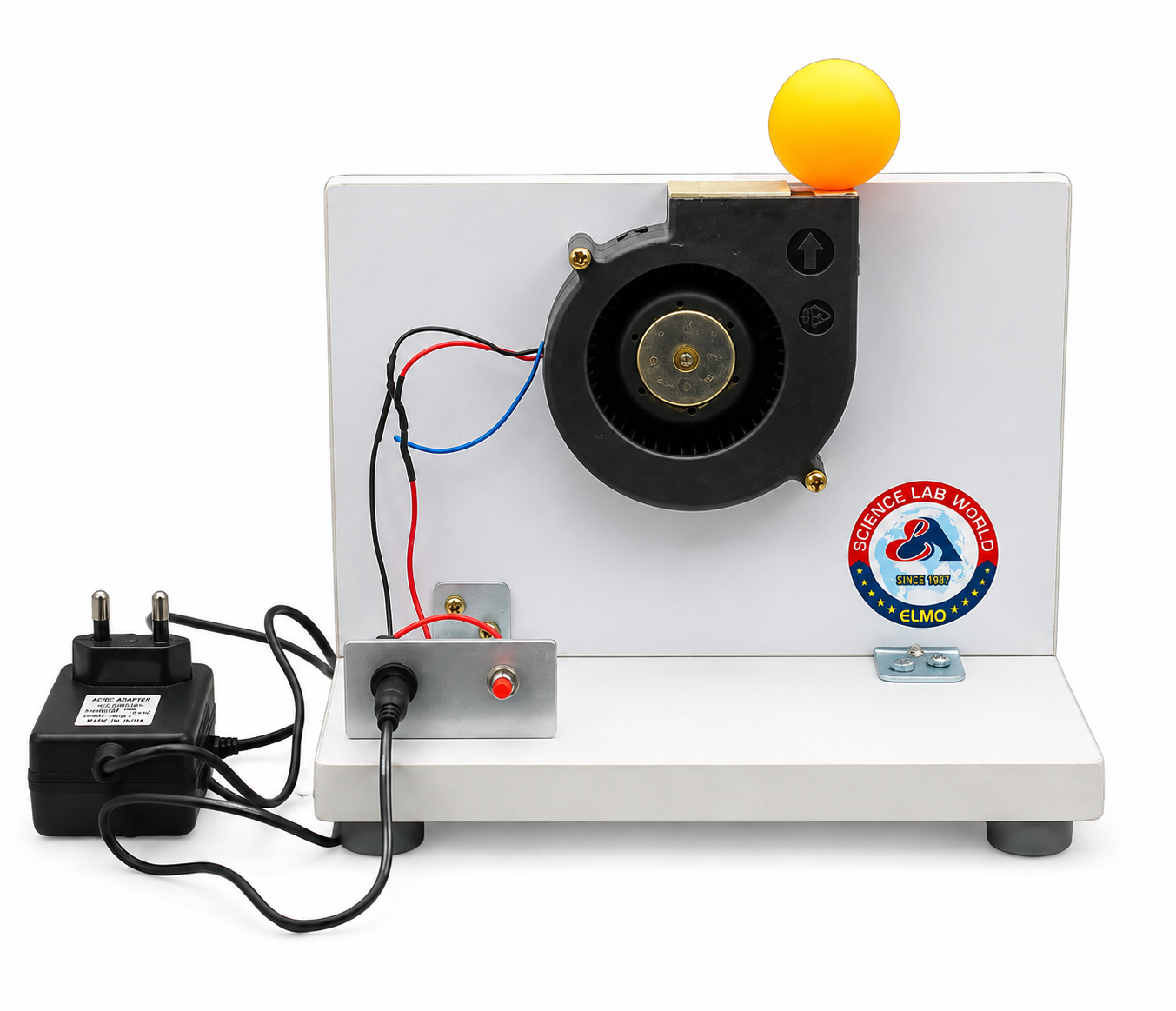
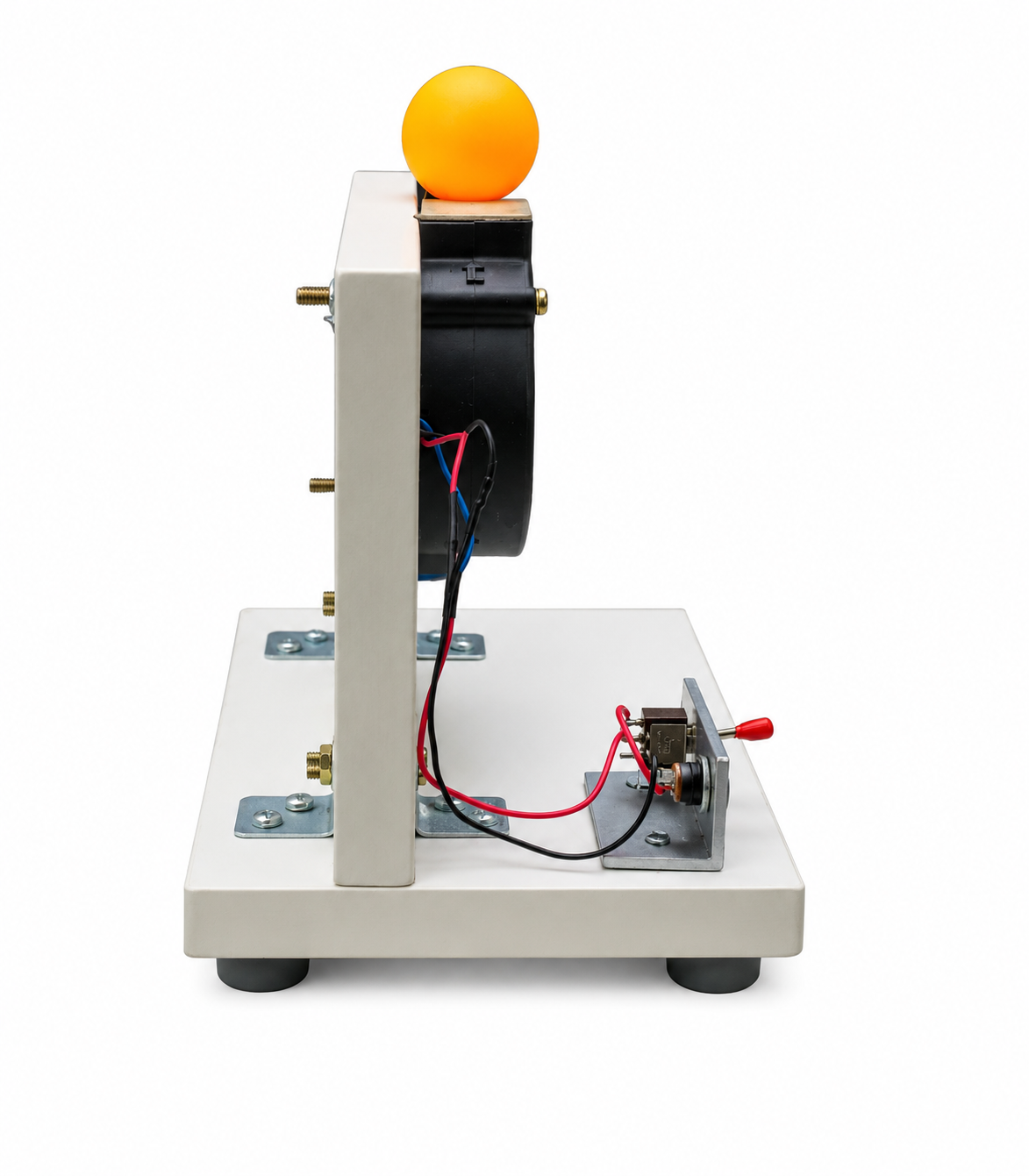
Bernoulli Principle Apparatus – Exploring Fluid Velocity, Pressure and Energy
Elmo Agencies, a trusted scientific manufacturer in Ambala, offers the Bernoulli Principle Apparatus, an educational apparatus designed to help students study the relationship between fluid velocity, pressure and energy in flowing fluids.
The model can be used in physics laboratories, school science classrooms, engineering demonstrations and STEM learning environments to provide a practical introduction to important concepts in fluid dynamics.
Bernoulli’s principle is commonly used to analyse idealised fluid flow and helps explain how changes in fluid velocity, pressure and height are related under suitable conditions.
What Is Bernoulli’s Principle?
Bernoulli Principle Apparatus describes a relationship between pressure, fluid velocity and gravitational potential energy for an ideal fluid flowing steadily along a streamline.
Bernoulli’s equation is commonly written as:
P + ½ρv² + ρgh = constant
Where:
- P = static pressure of the fluid
- ρ = density of the fluid
- v = flow velocity
- g = acceleration due to gravity
- h = height relative to a chosen reference level
The equation represents the conservation of mechanical energy per unit volume for an ideal fluid under appropriate conditions.
Understanding the Relationship Between Velocity and Pressure
A commonly taught simplified statement of Bernoulli’s principle is:
When the speed of a fluid increases, its static pressure may decrease.
However, this relationship applies within the conditions described by Bernoulli’s equation and should not be interpreted as meaning that faster-moving fluid always has lower pressure in every possible situation.
For steady, incompressible flow along a streamline, when the height remains approximately constant and energy losses are negligible, an increase in flow velocity is associated with a decrease in static pressure.
The Bernoulli Principle Apparatus helps students observe and discuss this relationship in a practical setting.
Basic Working Principle
In a typical demonstration, fluid flows through sections of a passage with different cross-sectional areas.
For steady incompressible flow, the continuity relationship is:
A₁v₁ = A₂v₂
Where:
- A represents cross-sectional area
- v represents average fluid velocity
When the cross-sectional area of a flow passage becomes smaller, the fluid velocity must increase to maintain the same volume flow rate.
If the conditions are appropriate for Bernoulli’s equation, this increase in velocity can be associated with a reduction in static pressure.
A Bernoulli Principle Apparatus can therefore help students compare pressure conditions at different points in a flowing fluid.
The Venturi Effect
One of the most common applications used to demonstrate Bernoulli’s principle is the Venturi effect.
A Venturi passage typically contains:
- A wider inlet section
- A narrowing section
- A narrow throat
- A widening outlet section
As fluid enters the narrow throat, its velocity increases.
Under suitable flow conditions, the static pressure at the throat is lower than in the wider section.
This pressure difference can be demonstrated using pressure indicators or liquid columns, depending on the design of the apparatus.
Educational Concepts Demonstrated
The Bernoulli Principle Apparatus can support the study of:
- Fluid pressure
- Fluid velocity
- Continuity of flow
- Bernoulli’s equation
- Conservation of mechanical energy
- Static pressure
- Dynamic pressure
- Venturi effect
- Pressure differences in flowing fluids
- Flow through changing cross-sectional areas
Bernoulli’s Equation and Energy
Bernoulli’s equation combines three forms of mechanical energy associated with a flowing fluid:
Pressure Energy
Pressure represents the energy associated with forces exerted by the fluid.
Kinetic Energy
The term ½ρv² represents the kinetic energy contribution associated with the motion of the fluid.
Gravitational Potential Energy
The term ρgh represents the energy contribution associated with the fluid’s height in a gravitational field.
Under the assumptions of ideal, steady flow, these terms can exchange with one another while the total mechanical energy along a streamline remains constant.
Classroom Demonstration Applications
Demonstrating Pressure Changes
Students can observe how pressure changes between wider and narrower sections of a flow passage.
Studying Fluid Velocity
The Bernoulli Principle Apparatus can be used to explain why fluid velocity changes when the cross-sectional area of a flow passage changes.
Understanding the Venturi Effect
Students can study the pressure reduction associated with increased velocity in the throat of a Venturi arrangement.
Connecting Theory with Experiment
The Bernoulli Principle Apparatus provides a practical way to compare observations with Bernoulli’s equation and continuity relationships.
About Airplane Wings and Bernoulli’s Principle
Bernoulli’s equation can be useful when analysing airflow around an aircraft wing, but the common explanation that air must travel faster over the top simply because it has a longer path is not a complete or generally correct explanation of lift.
Aircraft lift involves pressure differences around the wing and the downward deflection of air. The shape and angle of attack of the wing, together with the resulting flow pattern, are important factors.
Bernoulli’s principle and Newton’s laws can both be used to describe different aspects of the same aerodynamic behaviour.
The Bernoulli Principle Apparatus is primarily intended for studying fluid flow and pressure relationships rather than serving as a complete demonstration of aircraft lift.
Everyday and Engineering Applications
Bernoulli Principle Apparatus and related fluid-dynamic concepts are relevant to:
- Venturi meters
- Flow measurement systems
- Atomizers and spray devices
- Carburetion systems
- Aspirators
- Fluid transport systems
- Aerodynamic analysis
- Engineering fluid systems
The exact operation of individual devices may involve additional physical principles beyond Bernoulli’s equation.
Key Features of Bernoulli Principle Apparatus
- Designed to demonstrate the relationship between fluid velocity and pressure
- Supports practical study of Bernoulli’s principle
- Useful for demonstrating the Venturi effect
- Helps explain continuity of flow
- Supports physics and fluid mechanics education
- Suitable for laboratory and classroom demonstrations
The exact construction, materials, dimensions, pressure measurement arrangement and operating method may vary according to the specific model supplied.
How to Use the Bernoulli Principle Apparatus
The operating procedure depends on the design of the specific apparatus. A typical demonstration may involve:
- Establishing fluid flow through the apparatus.
- Observing the flow through sections with different cross-sectional areas.
- Comparing pressure readings or liquid levels at different measurement points.
- Identifying the section where the flow velocity is highest.
- Relating the observations to the continuity equation.
- Comparing the pressure differences with the principles described by Bernoulli’s equation.
Appropriate laboratory procedures should always be followed when operating equipment involving pressurised fluids, water or electrical components.
Ideal For
| Use Case |
Educational Purpose |
| Physics Laboratories |
Study pressure and velocity relationships |
| Fluid Mechanics Labs |
Demonstrate Bernoulli’s equation |
| Engineering Education |
Introduce practical fluid dynamics |
| STEM Classrooms |
Support hands-on science learning |
| Teacher Demonstrations |
Explain fluid flow concepts visually |
| Science Exhibitions |
Demonstrate the Venturi effect |
| Student Projects |
Explore pressure differences in flowing fluids |
Frequently Asked Questions
What does the Bernoulli Principle Apparatus demonstrate?
It helps demonstrate the relationship between fluid velocity, static pressure and mechanical energy under suitable fluid-flow conditions.
Why can pressure decrease when fluid velocity increases?
For steady, incompressible flow at approximately the same height and with negligible energy losses, Bernoulli’s equation shows that an increase in velocity is associated with a reduction in static pressure.
What is the Venturi effect?
The Venturi effect refers to the change in fluid velocity and pressure that occurs when fluid flows through a constricted section of a passage. The velocity increases in the narrow region, and under suitable conditions the static pressure decreases.
Does Bernoulli’s principle apply to every fluid flow situation?
No. Bernoulli’s equation is based on assumptions and is most directly applicable to steady flow under appropriate conditions. Real fluids may experience viscosity, turbulence and energy losses.
Can this model be used in school and college laboratories?
Yes. It is suitable for educational demonstrations in physics, fluid mechanics, engineering and STEM learning, depending on the level and configuration of the apparatus.
Who supplies the Bernoulli Principle Apparatus?
The model is supplied by Elmo Agencies, a scientific manufacturer in Ambala, providing educational science apparatus and demonstration equipment.
Why Choose Elmo Agencies?
Elmo Agencies supplies educational science equipment designed to support practical observation and demonstration. As a scientific manufacturer in Ambala, the company focuses on apparatus that helps students connect scientific theory with visible experiments and hands-on learning.
Conclusion
The Bernoulli Principle Apparatus provides a practical way to study the relationship between fluid velocity, pressure and mechanical energy. By demonstrating fluid flow through different sections and supporting the observation of pressure changes, the apparatus helps students connect Bernoulli’s equation and the continuity principle with real experimental observations.
Suitable for physics laboratories, fluid mechanics education, engineering institutions and STEM classrooms, this model provides an effective visual introduction to fundamental concepts in fluid dynamics.