Bicycle Wheel Gyroscope – Demonstration of Angular Momentum
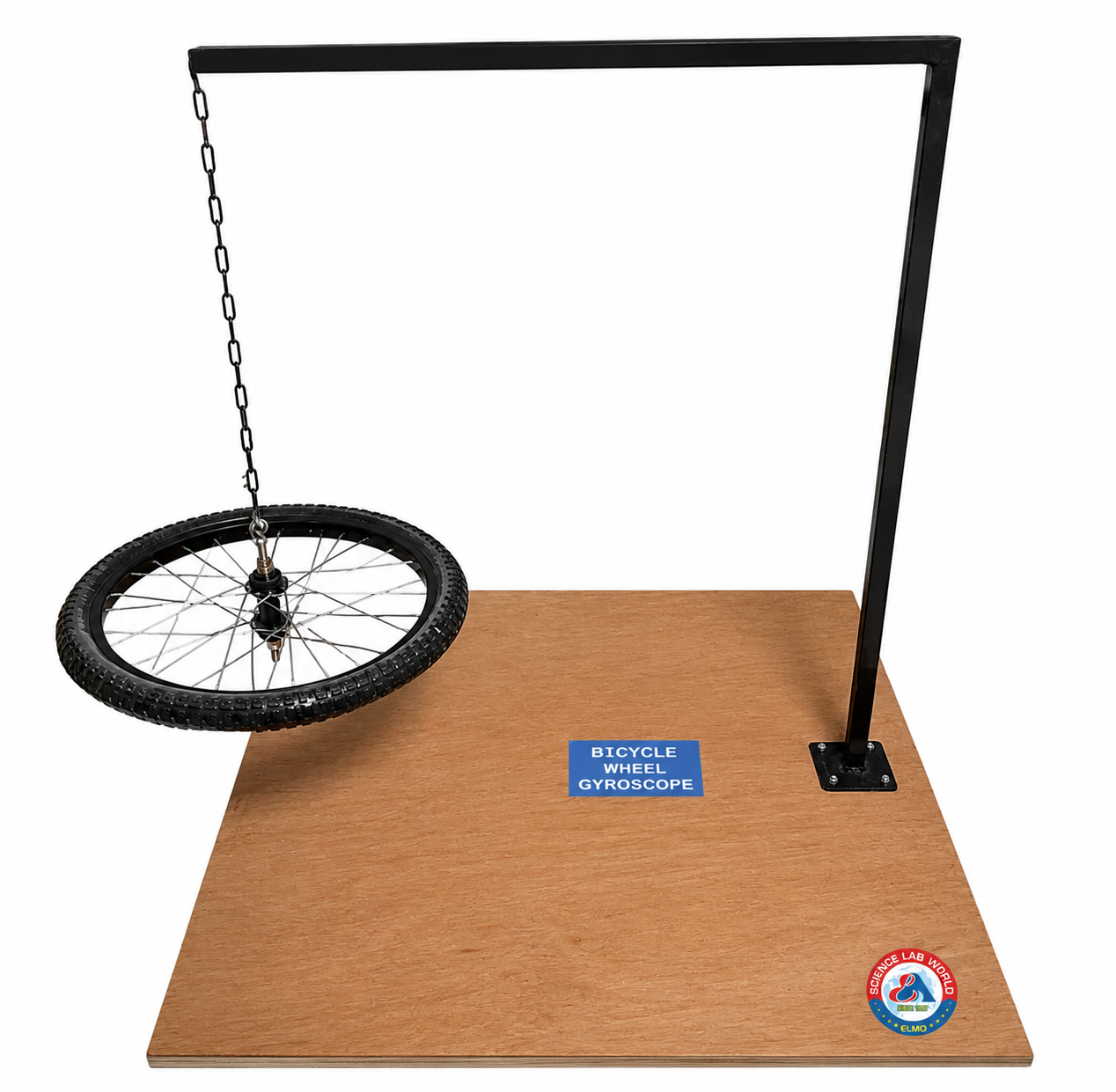
Elmo Agencies, a trusted scientific manufacturer in Ambala, presents the Bicycle Wheel Gyroscope, an educational physics apparatus designed to demonstrate the behaviour of a rotating body and the principles of angular momentum, rotational motion, torque, and gyroscopic precession.
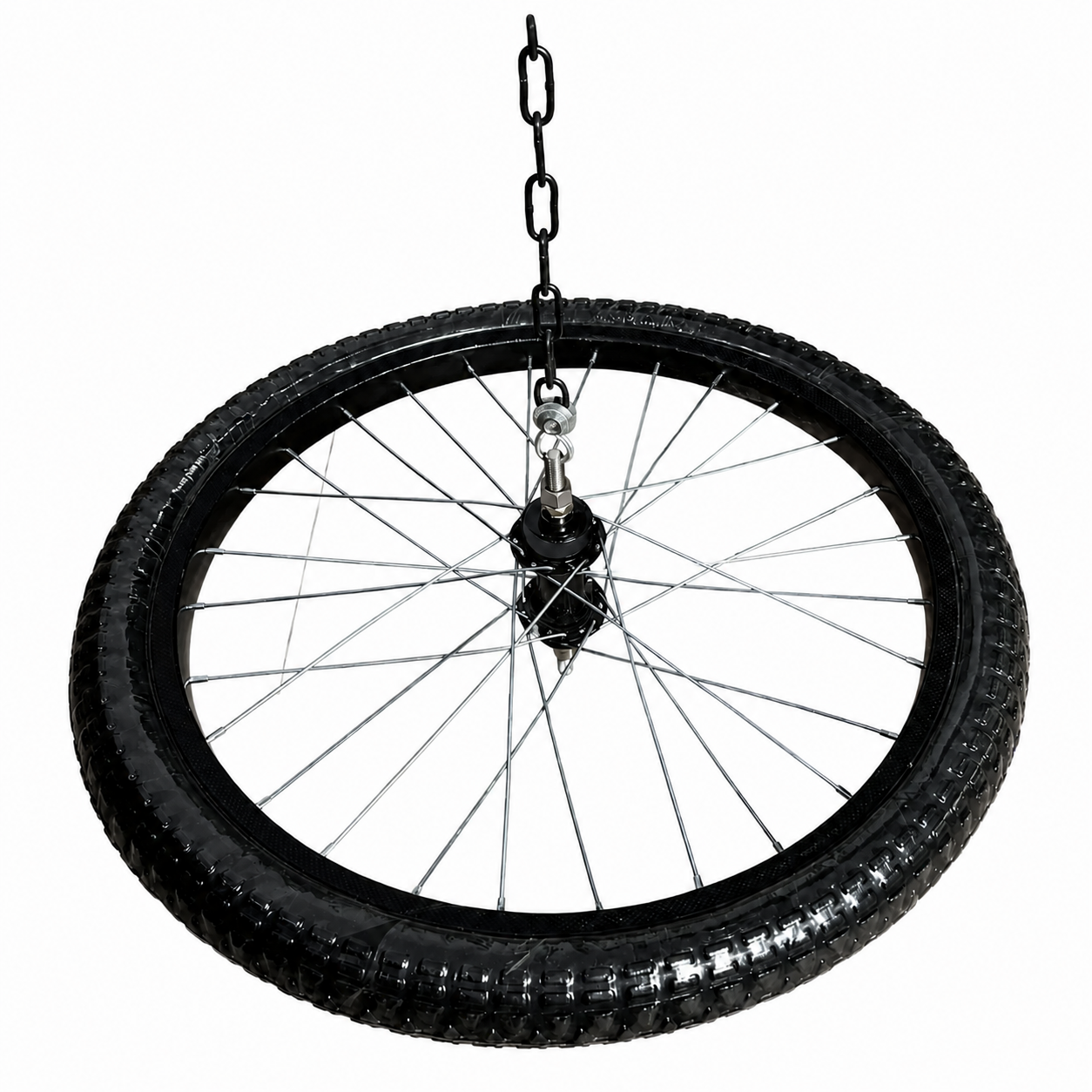
The apparatus typically consists of a balanced bicycle-type wheel mounted on an axle that can be held or supported while the wheel is spun. Once rotating, the wheel provides a clear and engaging way to study how a rotating system responds when an external torque is applied.
When the wheel is stationary, it can be tilted or rotated freely about its supporting axle. When the wheel is spinning, however, its angular momentum influences how the wheel responds to an externally applied torque.
Students can observe that the wheel does not always move in the direction they might initially expect when they apply a force to change its orientation.
This behaviour provides an effective demonstration of the relationship between:
- Rotational motion
- Angular momentum
- Torque
- Angular velocity
- Moment of inertia
- Gyroscopic precession
How Does the Bicycle Wheel Gyroscope Work?
When the wheel rotates, every part of the wheel contributes to the overall angular momentum of the system.
The amount of angular momentum depends on factors including:
- The moment of inertia of the wheel
- The rotational speed of the wheel
A faster-spinning wheel generally has a greater angular momentum than the same wheel spinning more slowly.
When an external torque is applied, the direction of the wheel’s angular momentum changes.
In a gyroscope, this can result in a motion known as gyroscopic precession, in which the axis of rotation changes direction in response to the applied torque.
The Bicycle Wheel Gyroscope allows students to observe this behaviour directly rather than studying it only through diagrams or mathematical explanations.
Understanding Angular Momentum
Angular momentum is a fundamental property of a rotating object.
A rotating wheel tends to maintain the direction of its angular momentum unless an external torque acts on it.
This does not mean that a spinning wheel is impossible to tilt or move. Rather, the motion produced by an applied force or torque depends on the wheel’s angular momentum and the direction of the applied torque.
The Bicycle Wheel Gyroscope provides a practical way to investigate how rotational speed and mass distribution influence rotational behaviour.
Demonstrating Gyroscopic Precession
One of the most interesting demonstrations with a spinning bicycle wheel occurs when the wheel is supported at one end of its axle.
Gravity produces a torque about the support point.
Instead of simply falling directly downward, a rapidly spinning wheel can rotate about a vertical axis. This motion is called gyroscopic precession.
The direction and rate of precession depend on factors such as:
- Direction of wheel rotation
- Direction of the applied torque
- Angular momentum of the wheel
- Position of the support point
This demonstration helps students understand that rotational systems respond differently from non-rotating objects.
Exploring the Effect of Rotational Speed
The wheel can be spun at different speeds to compare its behaviour.
Students may observe that increasing the rotational speed changes the wheel’s angular momentum and affects its response to an applied torque.
This makes the apparatus useful for comparative experiments involving rotational motion.
Possible investigations include:
- Comparing slow and fast rotation
- Observing changes in gyroscopic response
- Investigating precession
- Studying the effect of mass distribution
- Exploring the relationship between torque and rotational motion
Educational Concepts Demonstrated
The Bicycle Wheel Gyroscope can be used to study:
Angular Momentum
Demonstrates the rotational analogue of linear momentum.
Rotational Motion
Helps students observe the motion of a rotating body and its axis.
Torque
Shows how an external torque changes the motion of a rotating system.
Moment of Inertia
Encourages discussion about how the distribution of mass affects rotational behaviour.
Gyroscopic Precession
Demonstrates the motion of the rotational axis when torque acts on a spinning wheel.
Conservation Principles
Provides a practical basis for discussing the conservation of angular momentum when external torques are negligible.
Typical Apparatus Components
Depending on the model supplied, the Bicycle Wheel Gyroscope may include:
- Balanced bicycle-type wheel
- Central axle
- Handles or axle supports
- Bearings for smooth rotation
- Durable frame or wheel construction
The exact wheel diameter, material, bearing design and handle arrangement may vary according to the specific model.
Key Features
- Demonstrates angular momentum in a visible and practical way
- Suitable for experiments involving rotational motion
- Allows observation of gyroscopic precession
- Helps explain torque and moment of inertia
- Wheel can be operated at different rotational speeds
- Suitable for hands-on physics demonstrations
- Useful for school and college laboratories
Ideal For
| Use Case |
Educational Purpose |
| School Physics Laboratories |
Study rotational motion and gyroscopic effects |
| College Physics Labs |
Explore angular momentum and torque |
| STEM Classrooms |
Encourage hands-on mechanics learning |
| Teacher Demonstrations |
Visually explain gyroscopic precession |
| Science Exhibitions |
Demonstrate rotating motion interactively |
| Engineering Education |
Introduce principles of rotational dynamics |
Frequently Asked Questions
What does the Bicycle Wheel Gyroscope demonstrate?
It demonstrates the behaviour of a rotating body, including angular momentum, torque, moment of inertia and gyroscopic precession.
Why does a spinning wheel behave differently from a stationary wheel?
A spinning wheel possesses angular momentum. When an external torque acts on the wheel, the rotational axis responds according to the principles of rotational dynamics.
Does a faster-spinning wheel have greater angular momentum?
For the same wheel and mass distribution, increasing its rotational speed increases its angular momentum.
Can students perform hands-on experiments with this model?
Yes. The apparatus is suitable for demonstrations and practical experiments involving rotational speed, torque and gyroscopic motion.
Does a bicycle remain balanced only because of the gyroscopic effect?
No. Bicycle stability involves several factors, including steering geometry, rider control and the dynamics of forward motion. Gyroscopic effects can contribute but are not the only reason a bicycle remains stable.
Who supplies the Bicycle Wheel Gyroscope?
Elmo Agencies, a trusted scientific manufacturer in Ambala, supplies the Bicycle Wheel Gyroscope and offers educational science apparatus and physics laboratory equipment.
Why Choose Elmo Agencies?
Elmo Agencies supplies educational science apparatus designed to support practical learning and hands-on demonstrations. As a scientific manufacturer in Ambala, the company focuses on providing equipment that helps students understand scientific principles through observation and experimentation.
Conclusion
The Bicycle Wheel Gyroscope is an effective educational apparatus for demonstrating the fascinating behaviour of rotating objects. Through hands-on experiments, students can observe the effects of angular momentum, torque, moment of inertia, and gyroscopic precession.
Suitable for physics laboratories, STEM classrooms, engineering education, teacher demonstrations and science exhibitions, this apparatus transforms rotational mechanics from an abstract topic into an engaging and observable learning experience.