Floating Ball Model – Airflow and Bernoulli’s Principle Demonstrator
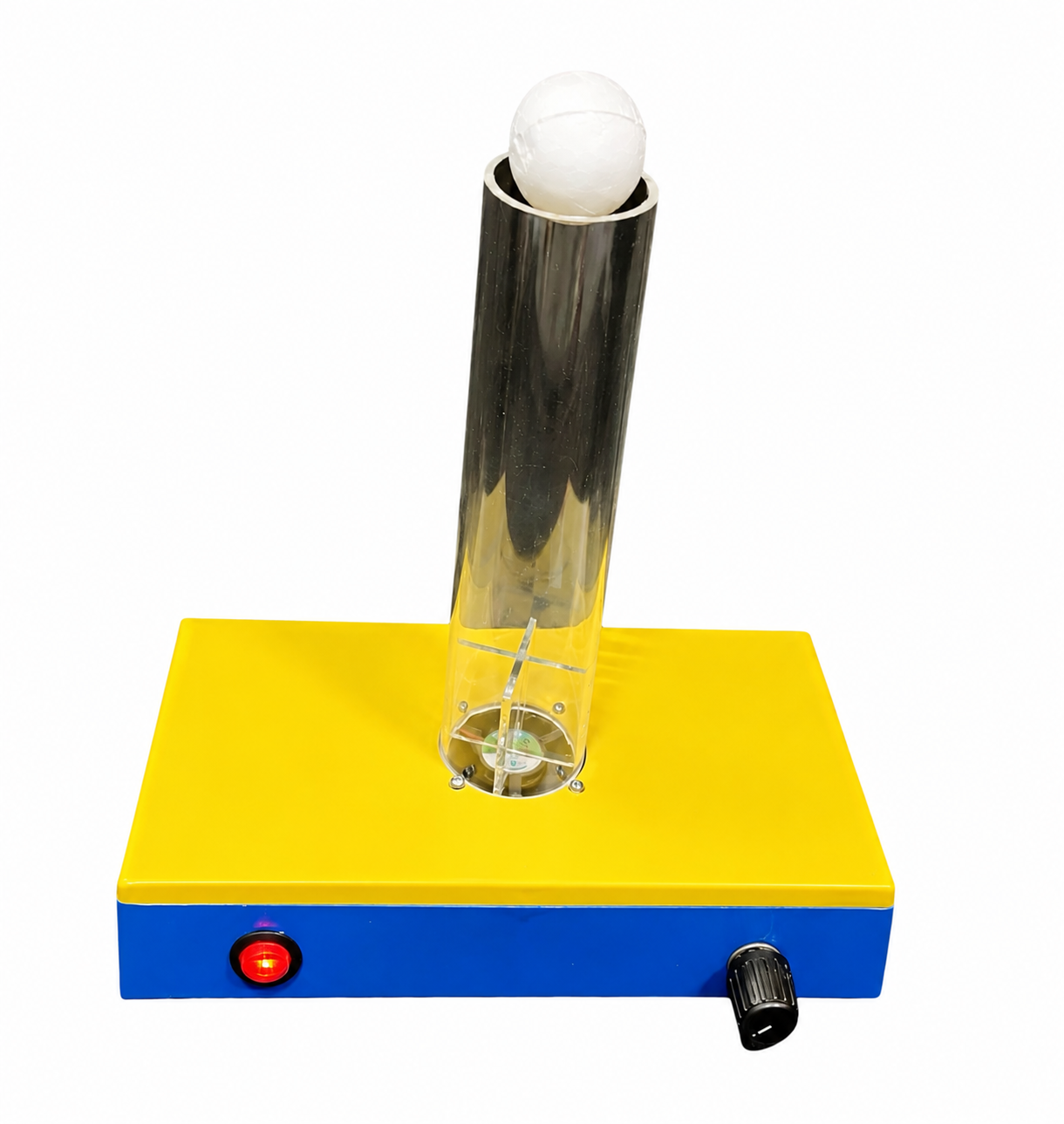
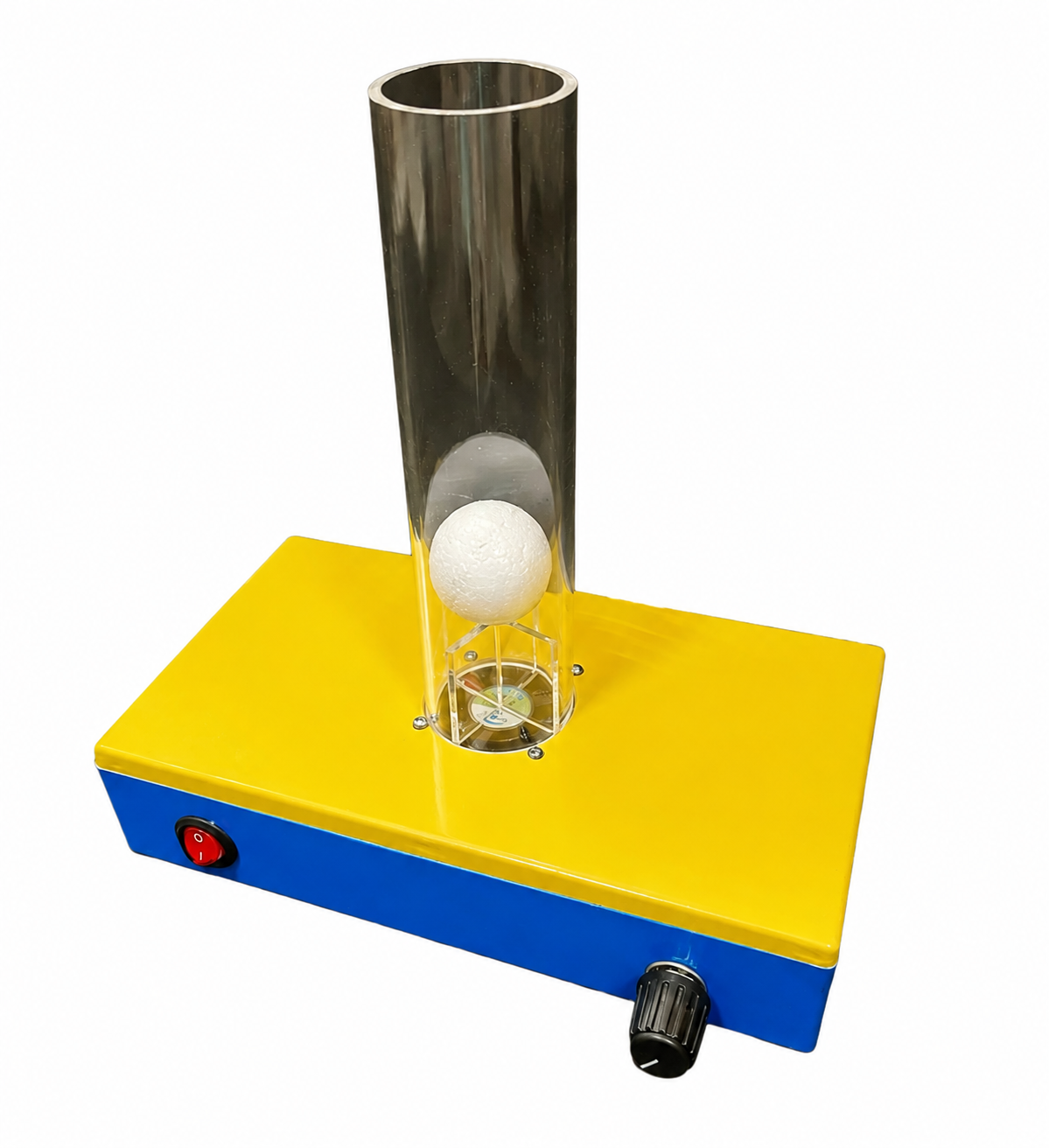
The Floating Ball Model by Elmo Agencies, a scientific manufacturer in Ambala, is an interactive physics demonstration apparatus designed to help students explore airflow, air pressure, forces, and basic fluid dynamics. Using a stream of moving air produced by an electric fan or blower, the model allows a lightweight ball to remain suspended in the air stream.
The Floating Ball Model consists of an electric fan or blower, a transparent acrylic tube or air column, and a lightweight ball. When the fan produces an upward stream of air, the moving air exerts an upward force on the ball.
When the upward aerodynamic force balances the downward force of gravity, the ball can remain suspended within the airflow. The experiment can also be used to discuss Bernoulli’s principle, airflow velocity, pressure differences, drag, and the stability of an object within a moving air stream.
How Does the Floating Ball Model Work?
When the electric fan is switched on, it creates a stream of air moving upward through the acrylic column.
The airflow produces an upward force on the lightweight ball. As the ball rises, its position changes until the forces acting on it become approximately balanced.
The ball can remain suspended because:
- The upward force produced by the moving air opposes gravity.
- Airflow around the ball can help restore it toward the centre of the air stream when it moves slightly sideways.
- Changes in airflow velocity and pressure around the ball contribute to its stability.
This makes the Floating Ball Model an effective visual demonstration of the interaction between airflow, pressure, aerodynamic forces, and gravity.
Typical Components
- Electric fan or blower unit
- Transparent acrylic tube or air column
- Lightweight plastic or foam ball
- Stable supporting base
- On/off switch
- Pre-assembled electrical connections
Key Features
- 🌬️ Produces a visible upward air stream
- 🔵 Demonstrates suspension of a lightweight ball in moving air
- 🧪 Supports the study of airflow and fluid dynamics
- 🔍 Transparent acrylic column allows clear observation
- 🎓 Interactive and engaging for classroom demonstrations
- 🏫 Suitable for physics labs, STEM activities, and science exhibitions
Educational Concepts Demonstrated
Airflow and Motion
Students can observe how moving air applies forces to an object and can support its weight.
Bernoulli’s Principle
The demonstration can help introduce the relationship between fluid velocity and pressure in flowing air, particularly when discussing the stability of the ball within the air stream.
Aerodynamic Forces
Students can explore the effects of drag and airflow on a lightweight object.
Force Balance
The suspended ball provides a practical example of forces acting in opposite directions and reaching an approximate balance.
Fluid Dynamics
The model offers an accessible introduction to the behaviour of moving fluids, with air acting as the fluid in this experiment.
Educational Applications
- Demonstrating airflow and aerodynamic forces
- Introducing Bernoulli’s principle and fluid behaviour
- Explaining the relationship between moving air and pressure
- Studying force balance and gravity
- Supporting hands-on physics and STEM education
- Creating engaging demonstrations for science fairs and exhibitions
Ideal For
| User Group |
Application |
| Schools |
Teaching airflow and basic fluid dynamics |
| Physics Labs |
Demonstrating forces and moving air |
| STEM Labs |
Hands-on scientific learning |
| Teachers |
Interactive classroom demonstrations |
| Science Exhibitions |
Visually engaging physics demonstrations |
Frequently Asked Questions
What does the Floating Ball Model demonstrate?
The model demonstrates how a stream of moving air can exert an upward force on a lightweight ball, allowing it to remain suspended when the upward aerodynamic force balances its weight.
Does the model demonstrate Bernoulli’s Principle?
It can be used to discuss Bernoulli’s principle and the relationship between airflow velocity and pressure.
Why does the ball remain inside the air stream?
When the ball moves slightly away from the centre of the airflow, differences in airflow around the ball can produce restoring effects that help it return toward the main airstream.
Is the model suitable for school students?
Yes. Its highly visible working principle makes it useful for physics classrooms, STEM activities, laboratory demonstrations, and science exhibitions.
Who supplies the Floating Ball Model?
The Floating Ball Model is supplied by Elmo Agencies, a scientific manufacturer in Ambala, providing educational science models and laboratory equipment for schools, colleges, and STEM learning.
Conclusion
The Floating Ball Model by Elmo Agencies provides a simple and visually effective way to study the behaviour of objects in moving air. By demonstrating airflow, aerodynamic forces, pressure effects, and the balance between upward force and gravity, the model makes important fluid dynamics concepts easier for students to observe and understand.