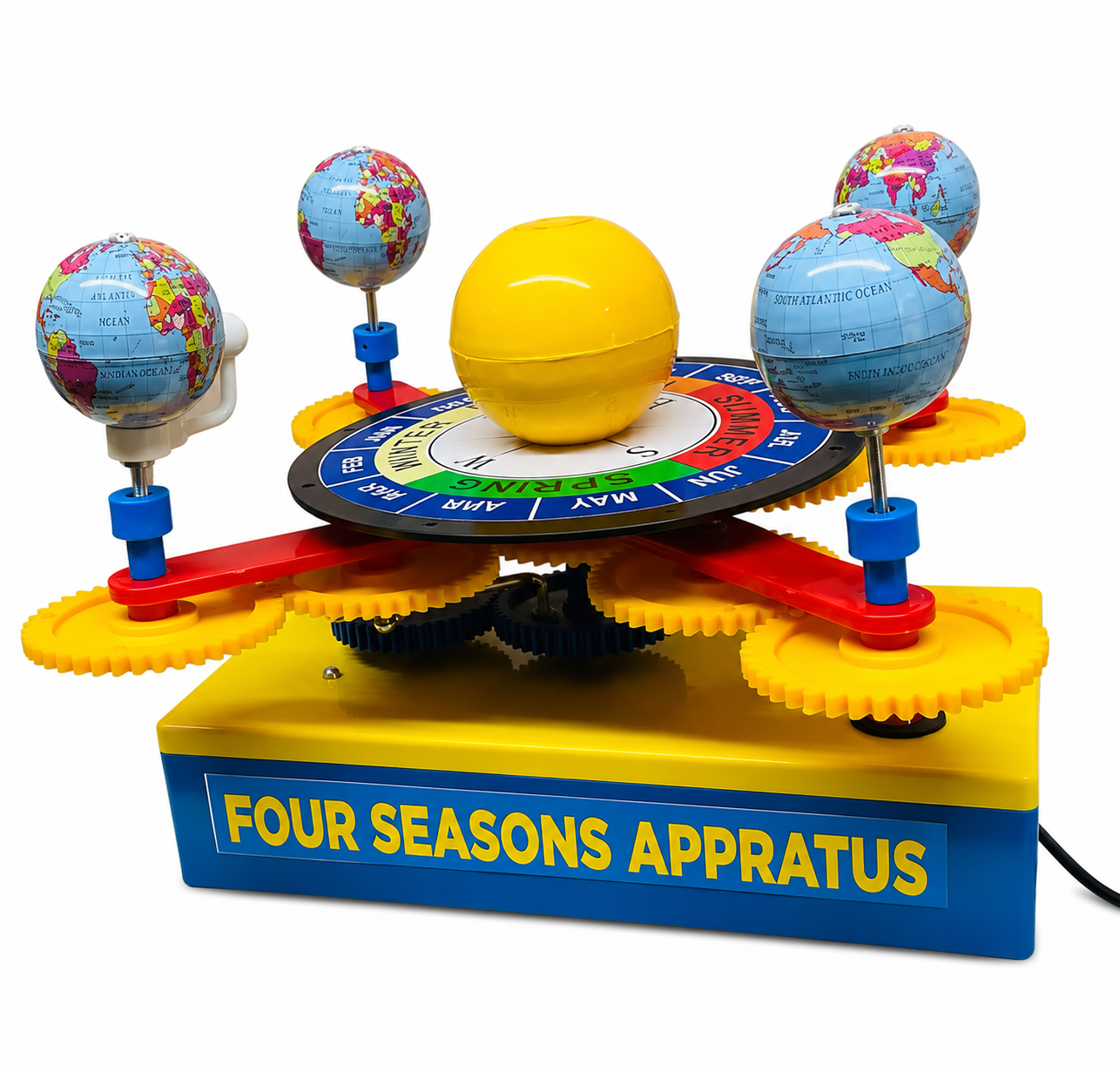
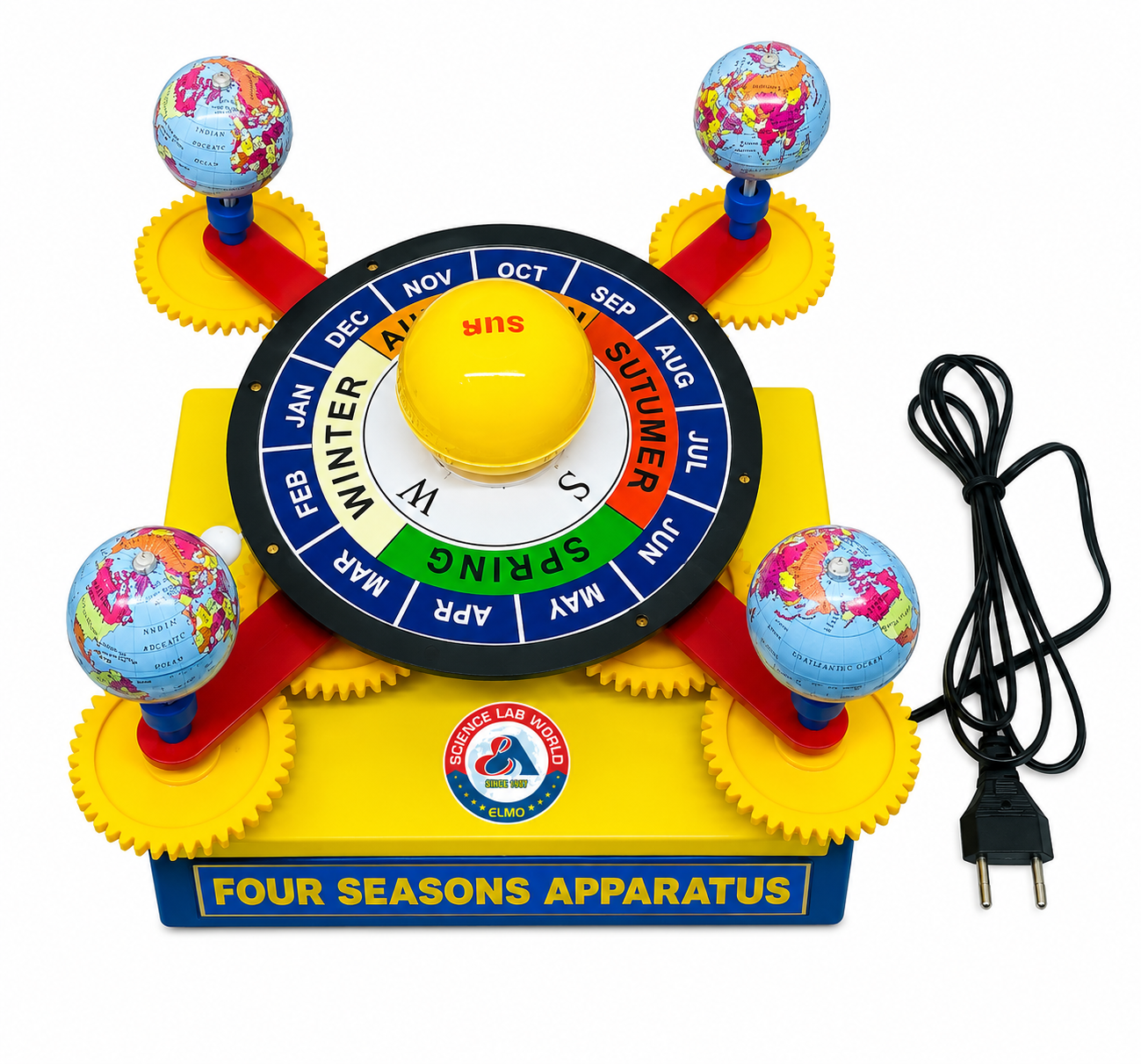
Four Seasons Working Model – Demonstrating Earth’s Tilt, Revolution and Seasonal Changes
Elmo Agencies, a trusted scientific manufacturer in Ambala, offers the Four Seasons Working Model, an educational demonstration model designed to help students understand how Earth’s axial tilt and its revolution around the Sun are responsible for seasonal changes.
The model provides a visual representation of the Earth-Sun system and helps explain why different parts of Earth receive varying amounts of sunlight during the year. It is useful for teaching the relationship between Earth’s approximately 23.5° axial tilt, its annual revolution around the Sun, and the changing seasons.
The Four Seasons Working Model is suitable for school science classrooms, STEM laboratories, geography lessons, astronomy demonstrations and science exhibitions.
What Does the Four Seasons Working Model Demonstrate?
The model represents the position of Earth at different points during its orbit around the Sun.
As Earth revolves around the Sun while maintaining the orientation of its tilted rotational axis, the Northern and Southern Hemispheres receive different angles and durations of sunlight throughout the year.
This results in seasonal changes.
The model can help students understand the occurrence of:
- Spring
- Summer
- Autumn
- Winter
- Summer and winter solstices
- Spring and autumn equinoxes
- Changes in the angle of incoming sunlight
- Changes in the duration of daylight
The Scientific Principle Behind Seasons
A common misconception is that seasons occur because Earth moves significantly closer to or farther away from the Sun.
The primary cause of Earth’s seasons is the tilt of Earth’s rotational axis.
Earth’s axis is tilted by approximately 23.5 degrees relative to the plane of its orbit around the Sun. As Earth completes one revolution around the Sun, the orientation of its axis causes different hemispheres to receive sunlight at different angles during different parts of the year.
When a hemisphere is tilted toward the Sun:
- Sunlight reaches the surface at a more direct angle.
- Days are generally longer.
- The hemisphere experiences warmer seasonal conditions.
When a hemisphere is tilted away from the Sun:
- Sunlight reaches the surface at a lower angle.
- Days are generally shorter.
- The hemisphere experiences cooler seasonal conditions.
Why Are the Seasons Opposite in the Two Hemispheres?
When the Northern Hemisphere is tilted toward the Sun, it experiences summer conditions while the Southern Hemisphere is tilted away and experiences winter conditions.
Approximately six months later, the situation is reversed.
This means that:
- Northern Hemisphere summer occurs during Southern Hemisphere winter.
- Northern Hemisphere winter occurs during Southern Hemisphere summer.
The Four Seasons Working Model helps students visualise this relationship by showing Earth at different positions in its orbit.
Solstices and Equinoxes
The model can also be used to introduce the major seasonal positions in Earth’s annual revolution.
Summer Solstice
A hemisphere is tilted most strongly toward the Sun, resulting in the greatest seasonal duration of daylight for that hemisphere.
Winter Solstice
A hemisphere is tilted most strongly away from the Sun, resulting in the shortest seasonal duration of daylight for that hemisphere.
Equinoxes
During the equinoxes, neither hemisphere is tilted strongly toward or away from the Sun. Day and night are approximately equal in length at many locations, although exact daylight duration can vary because of atmospheric effects and the definition of sunrise and sunset.
Educational Concepts Demonstrated
The Four Seasons Working Model can help explain:
- Earth’s revolution around the Sun
- Earth’s axial tilt
- Seasonal changes
- Direct and indirect sunlight
- Changes in daylight duration
- Opposite seasons in the Northern and Southern Hemispheres
- Solstices
- Equinoxes
- The Earth-Sun relationship
Educational Applications
School Science Classrooms
The model provides a visual method for explaining seasonal changes that may otherwise be difficult for students to imagine.
Geography Education
Students can study the relationship between Earth’s movement and changes in climate and seasonal conditions.
Astronomy Demonstrations
The model can support introductory discussions about Earth’s orbit, axial tilt and the Earth-Sun system.
STEM Learning
Students can observe how the position and orientation of a planet can influence the distribution of solar energy.
Science Exhibitions
The moving or positional demonstration of Earth around the Sun provides an engaging visual explanation for science exhibitions and educational displays.
Key Features
- Demonstrates the Earth-Sun relationship
- Helps explain Earth’s approximately 23.5° axial tilt
- Represents Earth’s revolution around the Sun
- Supports demonstrations of seasonal changes
- Useful for explaining solstices and equinoxes
- Provides a visual approach to teaching astronomy and geography
- Suitable for educational demonstrations and STEM activities
How the Model Is Used
- Position Earth at one of the designated points in its orbit around the Sun.
- Observe the orientation of Earth’s tilted axis.
- Identify which hemisphere is tilted toward the Sun.
- Discuss the angle and duration of sunlight received by each hemisphere.
- Move Earth through different positions in its orbit.
- Compare how the relationship between Earth and the Sun changes throughout the year.
- Identify the positions associated with the solstices and equinoxes.
Ideal For
| Use Case |
Educational Purpose |
| School Science Labs |
Explain seasons and Earth’s revolution |
| Geography Classes |
Study Earth’s movements and seasonal changes |
| STEM Laboratories |
Support hands-on scientific learning |
| Astronomy Education |
Demonstrate the Earth-Sun relationship |
| Science Exhibitions |
Provide a visual seasonal demonstration |
| Teacher Demonstrations |
Explain complex concepts clearly |
| Student Projects |
Explore Earth science and astronomy |
Frequently Asked Questions
What does the Four Seasons Working Model demonstrate?
The model demonstrates how Earth’s axial tilt and revolution around the Sun result in seasonal changes.
Are seasons caused by Earth being closer to the Sun?
No. The main reason for seasonal changes is the changing angle and duration of sunlight caused by Earth’s tilted axis as it revolves around the Sun.
Why are the seasons opposite in the Northern and Southern Hemispheres?
When one hemisphere is tilted toward the Sun, the other is tilted away from it. As a result, the hemispheres experience opposite seasonal conditions.
What are solstices and equinoxes?
Solstices occur when one hemisphere is tilted most strongly toward or away from the Sun. Equinoxes occur when neither hemisphere is tilted strongly toward or away from the Sun.
Who supplies the Four Seasons Working Model?
The model is supplied by Elmo Agencies, a scientific manufacturer in Ambala, providing educational science apparatus and demonstration models.
Why Choose Elmo Agencies?
Elmo Agencies supplies educational science equipment and practical demonstration models designed to support observation-based learning. As a scientific manufacturer in Ambala, the company focuses on providing educational apparatus that helps students understand scientific concepts through visual demonstration and practical learning.
Conclusion
The Four Seasons Working Model provides a clear visual explanation of one of the most important concepts in Earth science: the relationship between Earth’s axial tilt, its revolution around the Sun, and seasonal changes. Suitable for schools, STEM laboratories, geography classrooms, astronomy demonstrations, and science exhibitions, the model supports practical and visual learning of the Earth-Sun system.