
-35%

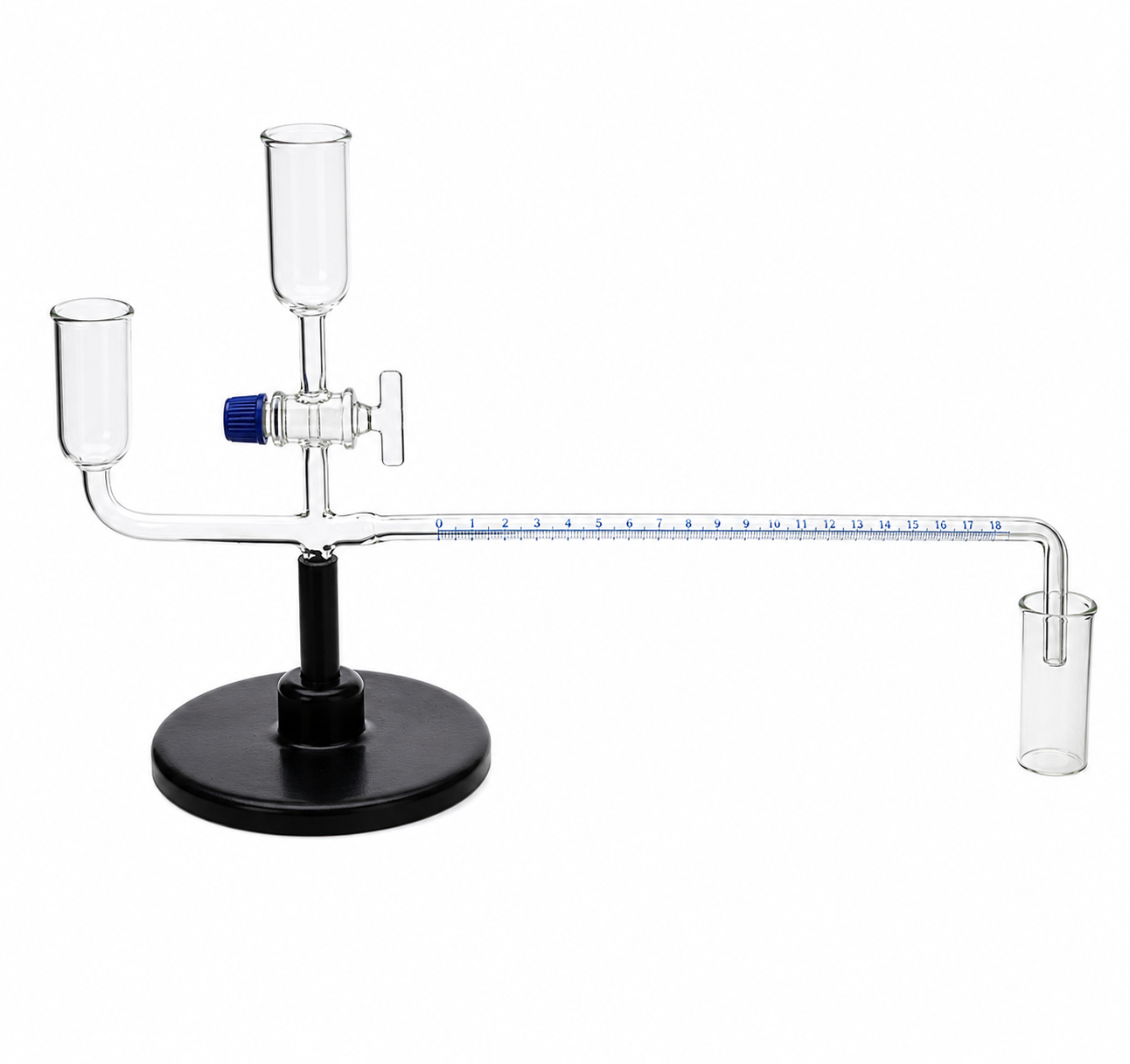
Ganong’s Potometer

  • A Ganong’s Potometer is a device that is used to measure water uptake by the plant shoot during transpiration. It is also known as a transpirometer.
  • It is used to measure the transpiration rate in a laboratory.
  • The Ganong’s Potometer comprises a glass tube, which is bent twice, and a glass cylinder having a wide mouth.

325.00 500.00

People watching this product now!
Description

Ganong’s Potometer – Laboratory Apparatus

The Ganong’s Potometer is a laboratory apparatus used to study water uptake by a leafy plant shoot as an indirect method for investigating transpiration. Supplied by Elmo Agencies, a scientific manufacturer in Ambala, it provides a practical setup for observing the movement of water through a plant stem under controlled experimental conditions.

A potometer does not measure transpiration directly. Instead, it measures the rate at which a cut plant shoot takes up water. Under suitable experimental conditions, this water uptake can be used as an indirect indication of transpiration.

The Ganong’s Potometer typically uses a graduated capillary tube and an air bubble to make water movement visible and measurable.

Construction

The apparatus generally consists of:

  • Bent glass tube
  • Graduated horizontal capillary tube
  • Water reservoir
  • Wide-mouthed glass cylinder
  • Rubber cork
  • Arrangement for introducing a freshly cut twig
  • Coloured water for improved visibility

The graduated section allows the movement of an air bubble to be observed over a measured distance.

Working Principle

A freshly cut leafy twig is fitted into the apparatus, and the system is filled with water without unwanted air leaks. An air bubble is introduced into the graduated capillary section and positioned at a known starting point.

As the shoot takes up water, the air bubble moves through the capillary. The distance travelled by the bubble over a known time can be recorded to compare water uptake under different experimental conditions.

Procedure of Ganong’s Potometer

  1. Fill the apparatus with water and ensure that the connections are properly sealed.
  2. Add a suitable dye to the water if required for easier observation.
  3. Insert a freshly cut leafy twig securely into the apparatus.
  4. Introduce an air bubble into the graduated capillary.
  5. Set the bubble to a known starting position.
  6. Record the distance travelled by the bubble over a measured period.
  7. Repeat the observations and compare the results.

Applications

  • Studying water uptake by plants
  • Investigating transpiration-related activity
  • Comparing transpiration under different conditions
  • Biology laboratory practicals
  • Educational demonstrations
  • Plant physiology experiments

Limitations

  • It measures water uptake rather than transpiration directly.
  • Not all water absorbed by a plant is necessarily lost through transpiration.
  • The cut twig may lose physiological activity over time.
  • Introducing and controlling the air bubble can require careful handling.
  • Temperature and other environmental changes can affect the readings.

Conclusion

The Ganong’s Potometer by Elmo Agencies is a useful laboratory apparatus for studying water uptake and its relationship to transpiration. By observing air-bubble movement through a graduated capillary, students can conduct comparative experiments and investigate how environmental conditions influence water movement in plants.

Specification