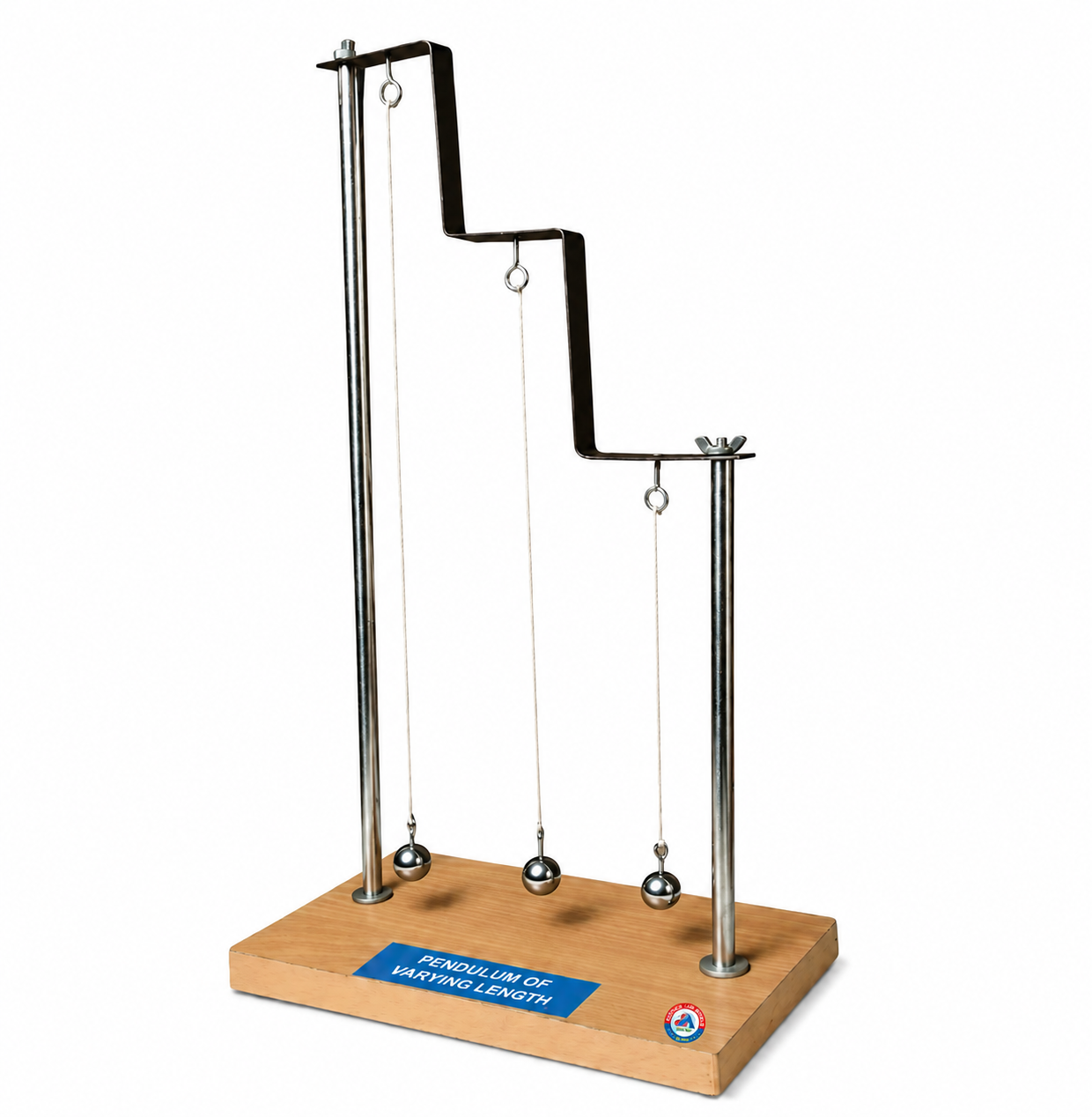
Pendulum of Varying Length Apparatus – Relationship Between Pendulum Length and Time Period
Elmo Agencies, a trusted scientific manufacturer in Ambala, presents the Pendulum of Varying Length Apparatus, a practical physics teaching apparatus designed to investigate the relationship between the length of a simple pendulum and its time period of oscillation.
The apparatus allows students to suspend a pendulum bob at different lengths and measure the time taken for a selected number of oscillations. By systematically changing the length of the pendulum while keeping other conditions as consistent as possible, students can study how the period changes with pendulum length.
This experiment provides a hands-on demonstration of oscillatory motion, periodic motion, gravity, and the behaviour of a simple pendulum. It is suitable for school and college physics laboratories.
What Does the Pendulum of Varying Length Apparatus Demonstrate?
The apparatus is used to investigate how the time period of a simple pendulum depends on its effective length.
For small angular displacements, an ideal simple pendulum follows the approximate relationship:
The experiment shows that the time period increases as the pendulum length increases.
Therefore, the period is proportional to the square root of the length when the acceleration due to gravity remains constant.
This makes the apparatus useful for verifying the relationship experimentally by comparing measured values of the period with different pendulum lengths.
How Does the Apparatus Work?
A pendulum bob is suspended from a fixed support using a string or suitable suspension arrangement.
The length of the pendulum can be adjusted to create different effective pendulum lengths. For each selected length, the pendulum is displaced through a small angle and released.
Students then:
- Measure the time taken for a selected number of complete oscillations.
- Divide the total time by the number of oscillations.
- Calculate the average time period.
- Repeat the procedure for different pendulum lengths.
- Compare the results.
For improved experimental accuracy, the timing can be repeated several times and an average value can be calculated.
Principle of the Experiment
A simple pendulum consists of a concentrated mass, called the pendulum bob, suspended from a fixed point by a light and flexible support.
When displaced from its equilibrium position and released, gravity provides a restoring force that causes the bob to oscillate.
For small angular displacements, the motion closely approximates simple harmonic motion.
The time period depends mainly on:
- The effective length of the pendulum
- The local acceleration due to gravity
For an ideal simple pendulum undergoing small oscillations, the period is independent of the mass of the bob.
In practical experiments, factors such as air resistance, friction at the support, the amplitude of oscillation and measurement error can affect the observed results.
Educational Concepts Demonstrated
Pendulum Length and Time Period
Students observe that a longer pendulum generally has a longer time period.
Oscillatory Motion
The apparatus demonstrates repeated motion about an equilibrium position.
Periodic Motion
Students measure the time required for one complete cycle of motion.
Simple Harmonic Motion
For sufficiently small angular displacement, the motion of a simple pendulum approximates simple harmonic motion.
Effect of Gravity
The experiment provides an opportunity to discuss how the acceleration due to gravity affects pendulum motion.
Experimental Data Analysis
Students can record observations and analyse the relationship between pendulum length and time period.
Suggested Experimental Procedure
- Set the pendulum to a selected length.
- Measure the effective length from the point of suspension to the centre of the pendulum bob.
- Displace the bob through a small angle.
- Release the bob without giving it an additional push.
- Measure the time taken for a suitable number of complete oscillations.
- Calculate the average time period.
- Repeat the experiment for different pendulum lengths.
- Compare the measured periods.
For graphical analysis, students may plot the time period against the square root of the pendulum length. For an ideal simple pendulum under small-angle conditions, the result should show an approximately linear relationship.
Typical Components
Depending on the model supplied, the apparatus may include:
- Sturdy support frame or stand
- Adjustable suspension point
- Pendulum string or suspension arrangement
- Pendulum bob or weight
- Scale or graduated arrangement for setting the pendulum length
- Clamps or adjustment mechanism
The exact design, dimensions and included accessories may vary according to the specific product model.
Key Features
- Allows variation of pendulum length
- Demonstrates the relationship between length and time period
- Suitable for repeated experimental measurements
- Supports practical study of oscillatory motion
- Useful for graphical and mathematical analysis
- Suitable for school and college physics laboratories
- Designed for classroom demonstrations and student experiments
Ideal For
| Use Case |
Educational Application |
| School Physics Laboratories |
Study pendulum motion and periodic motion |
| College Physics Labs |
Investigate oscillatory motion experimentally |
| STEM Classrooms |
Encourage measurement-based learning |
| Teacher Demonstrations |
Explain simple pendulum principles |
| Student Practical Work |
Record and analyse experimental data |
| Science Projects |
Explore relationships in periodic motion |
Frequently Asked Questions
What does the Pendulum of Varying Length Apparatus demonstrate?
It demonstrates the relationship between the effective length of a simple pendulum and its time period of oscillation.
What happens when the length of the pendulum is increased?
Under small-angle conditions, increasing the length increases the time period of the pendulum.
Does the mass of the pendulum bob affect the period?
For an ideal simple pendulum undergoing small oscillations, the period is independent of the mass of the bob.
Why should the pendulum be displaced through a small angle?
Keeping the angle of displacement small helps the motion more closely follow the assumptions used for the simple pendulum relationship.
How is the time period measured?
The time for several complete oscillations is measured and divided by the number of oscillations to obtain the average period.
What graph can students plot?
Students can plot the time period against the square root of the pendulum length to investigate the expected relationship.
Who supplies the Pendulum of Varying Length Apparatus?
The apparatus is supplied by Elmo Agencies, a trusted scientific manufacturer in Ambala, providing educational physics apparatus and laboratory equipment.
Why Choose Elmo Agencies?
Elmo Agencies supplies educational science equipment designed to support practical learning and scientific observation. As a scientific manufacturer in Ambala, we focus on laboratory apparatus that helps students connect theoretical physics concepts with measurable experiments.
Conclusion
The Pendulum of Varying Length Apparatus is an effective educational tool for investigating the relationship between pendulum length and time period. By changing the effective length of the pendulum and measuring the time taken for repeated oscillations, students can observe the principles of periodic motion, oscillation, gravity and simple harmonic motion in a practical way.