Crookes Radiometer – Demonstrating the Interaction of Light, Heat and Gas Molecules
Elmo Agencies, a trusted scientific manufacturer in Ambala, offers the Crookes Radiometer, commonly known as a light mill, as an educational demonstration apparatus for studying the interaction between light, heat, and gas molecules.
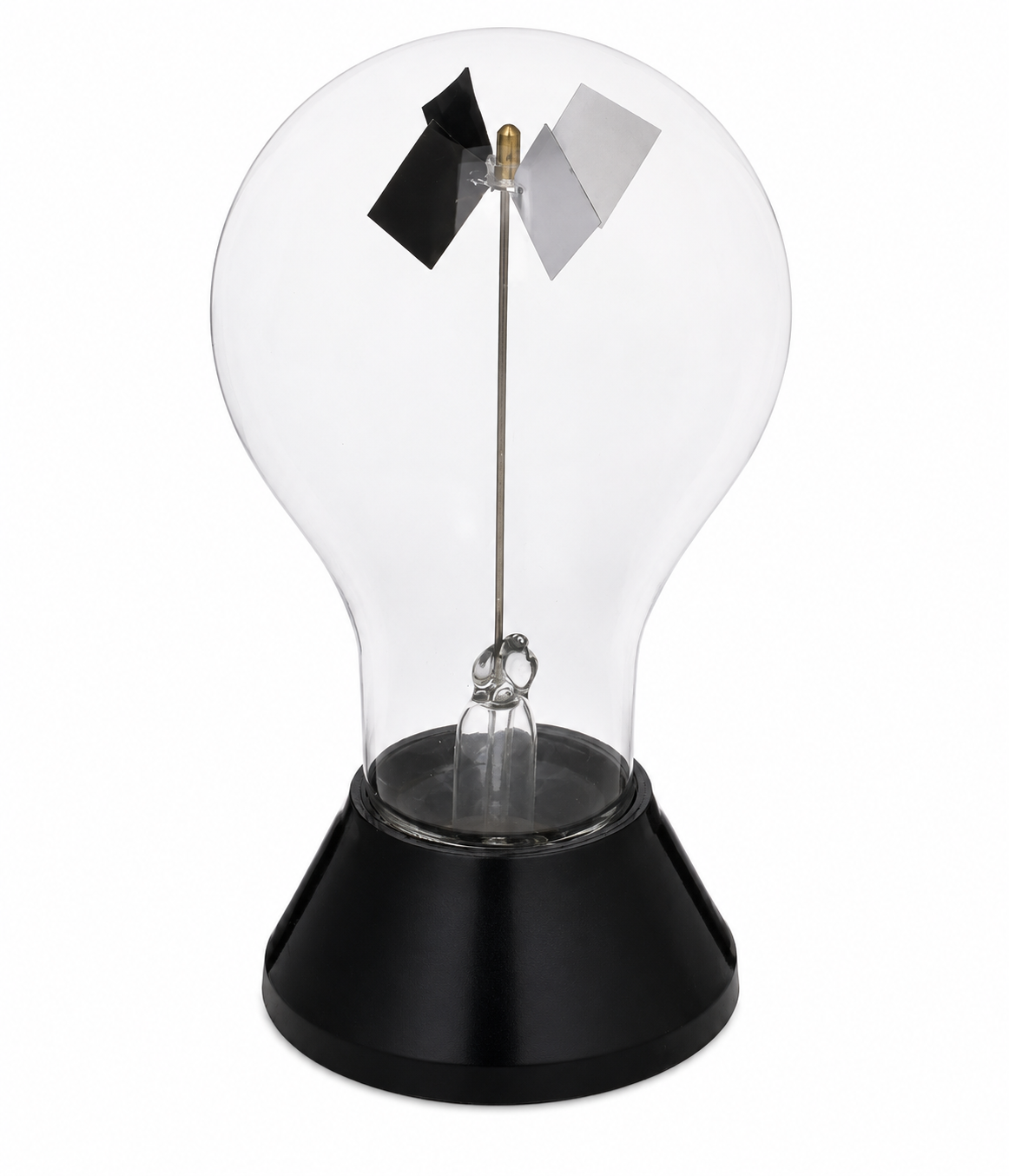
The Crookes Radiometer consists of lightweight vanes mounted on a low-friction spindle inside a sealed glass bulb containing gas at low pressure. When exposed to sufficiently strong light or radiant heat, the vanes rotate, providing an interesting demonstration of thermal effects in a partially evacuated environment.
A Crookes Radiometer is a device containing a set of lightweight vanes mounted on a central spindle.
Each vane typically has two differently treated surfaces:
- A dark or black surface that absorbs more incident radiation
- A lighter or reflective surface that absorbs less radiation
The vanes are enclosed inside a glass bulb containing a small amount of residual gas at low pressure. When the radiometer is exposed to a suitable light source, the vanes begin to rotate. The device is also commonly known as a light mill because of its visible rotation when illuminated.
Brief Historical Background
The Crookes Radiometer is associated with British scientist Sir William Crookes, who developed the device during the nineteenth century.
It became an important scientific curiosity because its rotation initially appeared to be a simple example of the mechanical pressure of light. Later scientific investigation showed that the operation of the familiar Crookes Radiometer is more strongly associated with thermal effects involving the residual gas inside the bulb.
How Does the Crookes Radiometer Work?
When light falls on the vanes, the darker surfaces generally absorb more energy and become warmer than the lighter or reflective surfaces.
This temperature difference affects the behaviour of the gas molecules near the surfaces of the vanes.
Because the bulb is not an ideal vacuum, the remaining gas plays an important role in producing the force that causes the vanes to rotate.
The resulting thermal interaction between the vane surfaces and the surrounding low-pressure gas produces a net force and torque on the vanes.
In the commonly observed radiometer, the dark sides move backward, meaning that the rotation is such that the black surfaces trail behind the lighter surfaces.
Why Is a Partial Vacuum Important?
The pressure inside the glass bulb is critical to the operation of the Crookes Radiometer.
If the bulb contained air at normal atmospheric pressure, collisions between gas molecules would strongly resist the movement and the characteristic radiometric effect would not operate in the same way.
At the other extreme, if the bulb contained an almost perfect vacuum, there would be too few gas molecules to produce the usual thermal effects responsible for the visible rotation.
The device therefore operates effectively within a suitable range of low gas pressure.
This makes the Crookes Radiometer useful for demonstrating that the behaviour of gases can change significantly under low-pressure conditions.
Thermal Effects and Radiometric Force
The explanation of the radiometer’s motion involves effects that occur when gas molecules interact with surfaces having different temperatures.
The darker surface of a vane becomes warmer when it absorbs more radiation. Gas molecules near the vane are affected by this temperature difference.
The interaction is more complex than simply imagining gas molecules pushing directly against one side with greater force.
In a low-pressure environment, thermal effects near the edges of the vanes contribute significantly to the resulting force and rotation.
For educational purposes, the radiometer can therefore be used to introduce discussions about:
- Absorption of radiant energy
- Temperature differences
- Heat transfer
- Gas molecule behaviour
- Low-pressure environments
- Thermal motion
- Torque and rotational motion
Does Radiation Pressure Cause the Rotation?
Light does carry momentum and radiation pressure is a real physical effect.
However, ordinary Crookes Radiometers are not primarily driven by radiation pressure.
The visible rotation of the familiar light mill is mainly associated with thermal interactions involving the residual gas inside the partially evacuated bulb.
In an extremely high vacuum, where gas-related thermal effects become very small, radiation pressure can act on surfaces, but the force is extremely small and does not explain the characteristic operation of a conventional Crookes Radiometer under ordinary conditions.
Educational Concepts Demonstrated
The Crookes Radiometer can support discussions involving:
- Interaction between light and matter
- Absorption and reflection of radiation
- Conversion of radiant energy into thermal energy
- Temperature differences
- Behaviour of gases at low pressure
- Molecular motion
- Thermal effects
- Torque and rotational motion
- Vacuum and partial vacuum
- Radiation pressure as a separate physical concept
Educational Applications
Physics Laboratories
The radiometer provides an interesting demonstration for discussions involving light, heat, molecular motion and gas behaviour.
STEM Education
Students can observe how a change in light exposure can produce visible mechanical motion through physical processes.
Thermodynamics Demonstrations
The apparatus can introduce discussions about temperature differences, energy transfer and molecular interactions.
Science Exhibitions
The visible movement of the vanes makes the Crookes Radiometer an engaging demonstration for science exhibitions.
Teacher Demonstrations
Teachers can use the device to encourage students to question and investigate the actual physical mechanism behind its motion.
Key Features
- Sealed glass bulb containing low-pressure gas
- Lightweight rotating vanes
- Differently treated vane surfaces for unequal absorption of radiation
- Low-friction spindle arrangement
- Visible rotation under suitable illumination
- Useful for demonstrating thermal effects and molecular interactions
- Suitable for physics and STEM education
The exact size, number of vanes and construction details may vary according to the specific model supplied.
How to Use the Crookes Radiometer
- Place the radiometer in a stable position.
- Expose the glass bulb to a suitable light source.
- Allow the vanes to receive sufficient illumination.
- Observe the direction and speed of rotation.
- Compare the response under different light intensities.
- Discuss how absorption of radiation creates temperature differences between the vane surfaces.
For reliable demonstrations, the apparatus should be handled carefully because the glass bulb and internal spindle assembly are delicate.
Ideal For
| Use Case |
Educational Purpose |
| Physics Laboratories |
Demonstrate light, heat and molecular interactions |
| STEM Education |
Explore energy transfer and rotational motion |
| Thermodynamics Lessons |
Discuss temperature differences and gas behaviour |
| School Science Classes |
Introduce scientific investigation |
| Science Exhibitions |
Provide an engaging working demonstration |
| Teacher Demonstrations |
Encourage discussion of scientific principles |
| Student Projects |
Explore the effect of light intensity on rotation |
Frequently Asked Questions
What is a Crookes Radiometer?
A Crookes Radiometer, also called a light mill, is a device containing rotating vanes inside a partially evacuated glass bulb. The vanes rotate when exposed to suitable illumination.
Why does the Crookes Radiometer rotate?
The familiar Crookes Radiometer rotates primarily because light produces temperature differences between the differently treated vane surfaces, creating thermal effects involving the residual gas inside the bulb.
Why are the vane surfaces black and light?
The darker surface generally absorbs more incident radiation and becomes warmer, while the lighter or reflective surface absorbs less. This temperature difference contributes to the radiometric effect.
Does the black side move toward or away from the direction of rotation?
In a conventional Crookes Radiometer, the black side generally trails during rotation, meaning it moves in the direction opposite to the leading edge of the vane.
Would the radiometer work in a perfect vacuum?
A conventional Crookes Radiometer would not show its usual strong thermal gas effect in a perfect vacuum because residual gas molecules are important to its operation.
Is radiation pressure responsible for the visible rotation?
Radiation pressure exists, but it is not the primary cause of the characteristic rotation of a conventional Crookes Radiometer.
Who supplies the Crookes Radiometer?
The Crookes Radiometer is supplied by Elmo Agencies, a scientific manufacturer in Ambala, providing educational science apparatus and demonstration equipment.
Why Choose Elmo Agencies?
Elmo Agencies supplies educational science equipment designed to support observation, experimentation and practical learning. As a scientific manufacturer in Ambala, the company focuses on educational apparatus that helps students explore scientific concepts through visible demonstrations.
Conclusion
The Crookes Radiometer is an engaging educational apparatus that demonstrates the interaction between light, thermal energy and gas molecules in a low-pressure environment. Its rotating vanes provide a visible starting point for exploring radiation absorption, temperature differences, molecular behaviour and rotational motion. Suitable for physics classrooms, STEM laboratories, thermodynamics demonstrations and science exhibitions, the Crookes Radiometer helps make abstract concepts involving light, heat and molecular motion easier to observe and discuss.