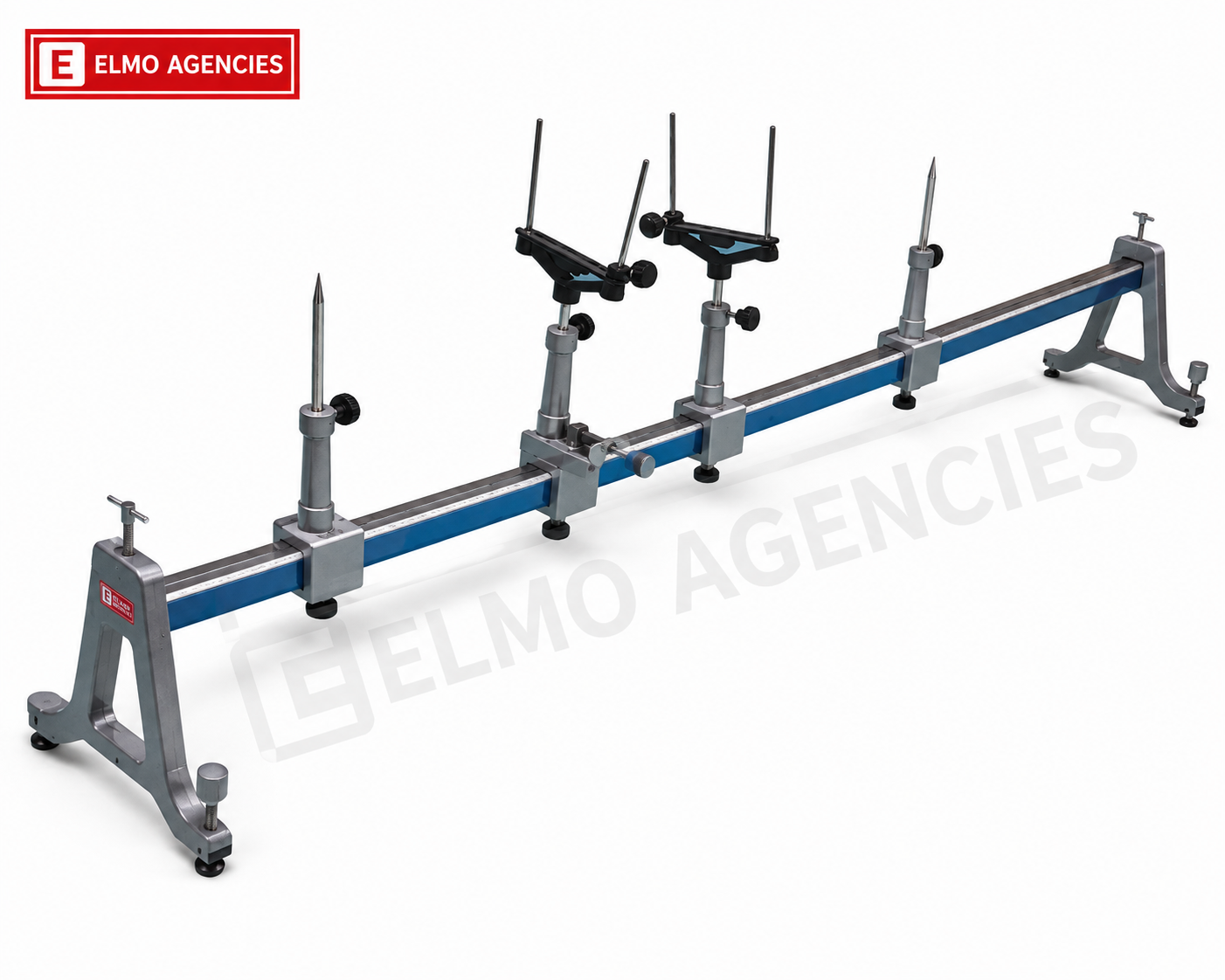
Optical Bench | Precision Apparatus for Optics Experiments
The Optical Bench by ELMO Agencies is a precision laboratory apparatus designed for conducting a wide range of optics and light experiments. It provides a stable platform for mounting and aligning optical components such as lenses, mirrors, prisms, light sources, and screens along a common optical axis.
Widely used in schools, colleges, universities, physics laboratories, and STEM learning centers, the optical bench helps students understand image formation, reflection, refraction, focal length determination, and other fundamental principles of geometrical optics.
As a trusted scientific manufacturer in Ambala, ELMO Agencies supplies high-quality educational and laboratory equipment built for accuracy, durability, and long-term performance.
What Is an Optical Bench?
An Optical Bench is a rigid and accurately calibrated platform used to support optical components during experiments. It allows various optical devices to be positioned precisely along a straight guide rail, ensuring proper alignment and accurate experimental results.
The bench is designed to minimize vibrations and maintain stable alignment, making it ideal for educational demonstrations and scientific investigations.
Components of an Optical Bench
A standard optical bench typically includes:
📏 Precision guide rail with measurement scale
🔦 Light source
🔲 Adjustable slit
🪞 Optical component holders
📺 Image screen
⚙️ Sliding carriers or moving mounts
🔍 Lens holders
🔺 Prism holders
📐 Position indicators for accurate measurements
Additional optical accessories can be mounted depending on the experiment being performed.
Educational Applications
Image Formation Studies
Observe and analyze image formation by lenses and mirrors.
Reflection and Refraction Experiments
Study the behavior of light when it encounters reflective and transparent surfaces.
Focal Length Determination
Determine the focal length of convex lenses and concave mirrors.
Total Internal Reflection
Investigate critical angle and total internal reflection phenomena.
Refractive Index Measurement
Measure refractive indices using prisms and semi-circular lenses.
STEM Learning Programs
Encourage hands-on experimentation and scientific investigation.
Key Features
🔬 Precision optical alignment system
📏 Graduated guide rail for accurate measurements
⚙️ Adjustable optical component holders
🏫 Ideal for schools, colleges, and laboratories
🔍 Suitable for multiple optics experiments
🧪 Durable and stable laboratory construction
📘 Supports curriculum-based physics practicals
🎓 Promotes practical learning and experimentation
Working Principle
The optical bench allows optical elements to be positioned along a common axis. By adjusting the location of lenses, mirrors, prisms, and screens, students can observe how light behaves and forms images under different conditions.
Accurate positioning enables precise measurement of distances, focal lengths, angles, and image characteristics.
Essential Guidelines for Using an Optical Bench
Proper Leveling
Use the leveling screws and spirit level to ensure the bench is perfectly horizontal.
Optical Alignment
Align all optical components along the same optical axis to obtain accurate results.
Component Calibration
Check the position of each optical element before conducting experiments.
Stable Mounting
Secure all accessories firmly to minimize movement and measurement errors.
Common Experiments Performed
🔍 Determination of focal length of convex lenses
🪞 Determination of focal length of concave mirrors
🌈 Refraction through glass slabs and prisms
💡 Study of image formation by lenses
📐 Verification of Snell’s Law
🔄 Total Internal Reflection experiments
📊 Refractive Index measurements
Benefits
✅ Accurate and reliable optical experiments
✅ Supports practical understanding of optics
✅ Easy setup and adjustment of components
✅ Suitable for classroom demonstrations and laboratory work
✅ Durable construction for long-term educational use
Ideal For
- Physics Laboratories
- Schools and Colleges
- Universities
- STEM Learning Centers
- Science Exhibitions
- Teacher Training Programs
- Educational Institutions
Frequently Asked Questions (FAQ)
Q1: What is an Optical Bench used for?
A: It is used to conduct optics experiments involving lenses, mirrors, prisms, image formation, and light behavior.
Q2: What are the main components of an Optical Bench?
A: It typically includes a guide rail, light source, slit, image screen, optical holders, and sliding mounts.
Q3: Why is proper alignment important?
A: Proper alignment ensures accurate image formation and reliable experimental results.
Q4: Which subjects use an Optical Bench?
A: It is primarily used in physics, optics, and STEM education.
Q5: Can it be used for focal length determination?
A: Yes, it is commonly used to determine the focal length of lenses and mirrors.
Q6: Who supplies the Optical Bench?
A: ELMO Agencies, a trusted scientific manufacturer in Ambala, supplies high-quality optical and laboratory equipment for educational institutions.
Why Choose ELMO Agencies?
🏭 Trusted scientific manufacturer in Ambala
🔬 High-quality optics and laboratory equipment
🎓 Preferred by schools, colleges, and universities
📦 Bulk orders and institutional supply available
🚚 Nationwide and international delivery support
Conclusion
The Optical Bench by ELMO Agencies is an essential laboratory apparatus for studying optics and image formation. Its precision design, stable construction, and versatile functionality make it an indispensable tool for physics education, STEM learning, and scientific experimentation.