
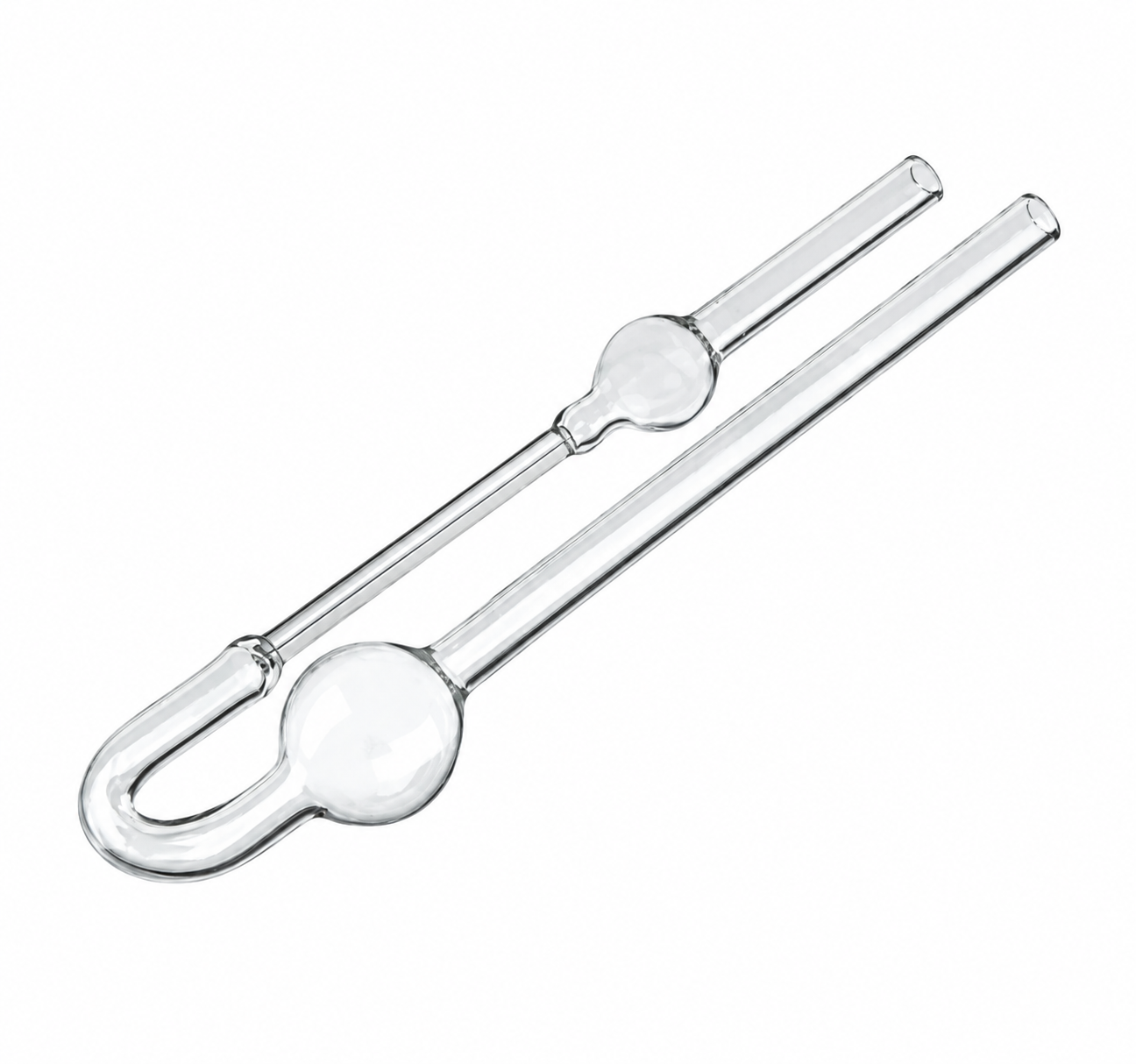
Ostwald Viscometer
The Ostwald Viscometer by Elmo Agencies is a glass U-tube instrument with a capillary section, designed to measure and compare the viscosity of liquids by recording their flow time under controlled laboratory conditions.
- Viscosity measurement: Used to compare the flow behaviour and relative viscosity of liquids and solutions.
- Capillary U-tube design: Allows liquid to flow through a narrow capillary between specified reference marks.
- Physical chemistry applications: Suitable for viscosity experiments in school, college, university, and laboratory settings.
- Polymer solution studies: Can be used for intrinsic viscosity experiments and related polymer studies when the appropriate calculation method is followed.
- Overall height: 237 mm.
- Supplied by Elmo Agencies: Suitable for educational institutions, laboratories, and bulk laboratory equipment requirements.
₹40.00 ₹100.00
- To pick up today
- Free
- More details
- More details
Ostwald Viscometer – Capillary Viscometer for Liquid Viscosity
The Ostwald Viscometer is a glass capillary instrument used to measure and compare the viscosity of liquids by determining the time required for a liquid to flow between specified marks under gravity. Supplied by Elmo Agencies, a trusted scientific manufacturer in Ambala, it is suitable for physical chemistry practicals, educational laboratories, and viscosity studies.
An Ostwald viscometer consists of a glass U-shaped tube with a narrow capillary section and calibrated timing marks. A liquid is drawn above the upper mark and allowed to flow through the capillary. The time taken for the liquid level to move between the reference marks is recorded.
A more viscous liquid generally takes longer to pass through the capillary under the same experimental conditions.
Principle of Ostwald Viscometer
The instrument works on the principle of capillary flow under gravity. For comparative measurements, the viscosity of an unknown liquid can be related to a reference liquid using factors such as flow time and density, provided measurements are performed under controlled conditions.
Temperature is particularly important because the viscosity of liquids changes with temperature.
Working Procedure
- Clean and prepare the viscometer properly.
- Introduce the required liquid into the instrument.
- Allow the liquid to reach the required experimental temperature.
- Draw the liquid above the upper timing mark.
- Allow it to flow naturally through the capillary.
- Record the time taken for the meniscus to pass between the specified marks.
- Repeat the measurement and use the appropriate calculation method.
Applications
- Comparing viscosity of liquids
- Physical chemistry practicals
- Studying liquid flow behaviour
- Viscosity experiments with solutions
- Dilute polymer-solution studies
- Chemistry laboratory demonstrations
- College and university practical work
Technical Specifications
| Specification | Details |
|---|---|
| Product | Ostwald Viscometer |
| Design | Glass U-tube with capillary |
| Overall Height | 237 mm |
| Primary Application | Liquid viscosity measurement and comparison |
| Additional Application | Viscosity studies of dilute polymer solutions |
| Suitable For | Physical chemistry and educational laboratories |
| Origin | Ambala, India |
Importance of Temperature Control
Temperature should be kept consistent during viscosity measurements because liquid viscosity is temperature-dependent. Using the same temperature for the reference and test liquid helps produce more reliable comparative results.
A clean capillary, proper filling, consistent temperature, and careful timing are also important for repeatable measurements.
Conclusion
The Ostwald Viscometer by Elmo Agencies is a practical glass instrument for viscosity measurement and comparison of liquids. Its capillary-flow design makes it particularly suitable for physical chemistry experiments, viscosity practicals, educational laboratories, and dilute polymer-solution studies.
- Overview
Related products
-
Chemistry, Glassware
Iodine Flask
0 out of 5(0)- The Iodine Flask is made from Borosilicate glass for iodine value determination, with an interchangeable stopper.
- Available capacities: 100ml, 250ml, 500ml.
SKU: n/a₹95.00 – ₹165.00Price range: ₹95.00 through ₹165.00 This product has multiple variants. The options may be chosen on the product page -
Chemistry, Glassware
Stalagmometer
0 out of 5(0)A Stalagmometer is a simple, hand-operated device used to measure the surface tension of liquids. It can also measure the tension between two liquids, but this is less common. To measure the tension, you simply determine the mass or volume of liquid drops falling from the tip of a vertical tube after passing through it.
SKU: n/a -
Chemistry, Glassware
Wilmott’s Bubbler – Photosynthesis Experiment Apparatus (250 mL)
0 out of 5(0)Wilmott’s Bubbler: a classic borosilicate-glass apparatus for demonstrating photosynthesis by observing the release of gas (oxygen) from aquatic plants under light.
- 250 mL borosilicate flask fitted with a cork and an inserted glass tube
- The second glass tube acts as a water reservoir over the upper half of the inner tube, making the rate of bubbling easy to observe
- Ideal for demonstrating the effect of light intensity on photosynthesis rate
- Widely used in Class 10–12 biology practicals (CBSE, ICSE, State Boards) and B.Sc. Botany / Life Sciences labs
SKU: n/a -
Chemistry, Glassware
Millipore Filter Apparatus – Borosilicate Vacuum Filtration Assembly
0 out of 5(0)Millipore Filter Apparatus: a complete borosilicate-glass vacuum filtration assembly for lab use in mobile phase (HPLC) filtration, tissue culture media, biological fluids, and other aqueous solutions.
- High-quality borosilicate glass throughout — funnel, flask, and base
- 300 ml funnel + 1000 ml flask + 47 mm vacuum base + 47 mm aluminium clamp
- Sintered disk filter: G2 porosity (40–90 micron), effective filtration area 9.6 cm²
- Designed to maximise flow and reduce foaming
SKU: n/a
