Viscosity Tube Model – Set of 4 Tubes | Elmo Agencies
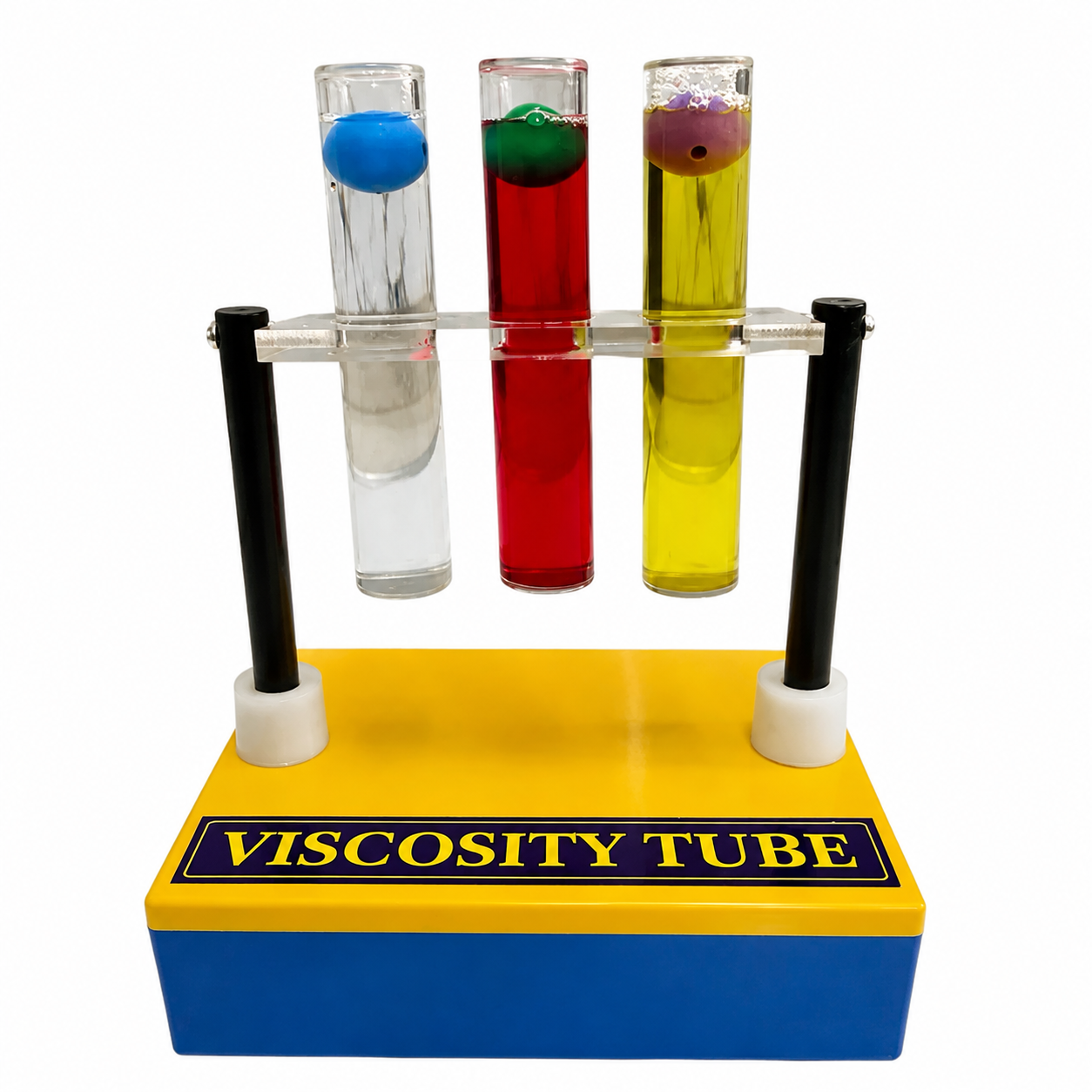
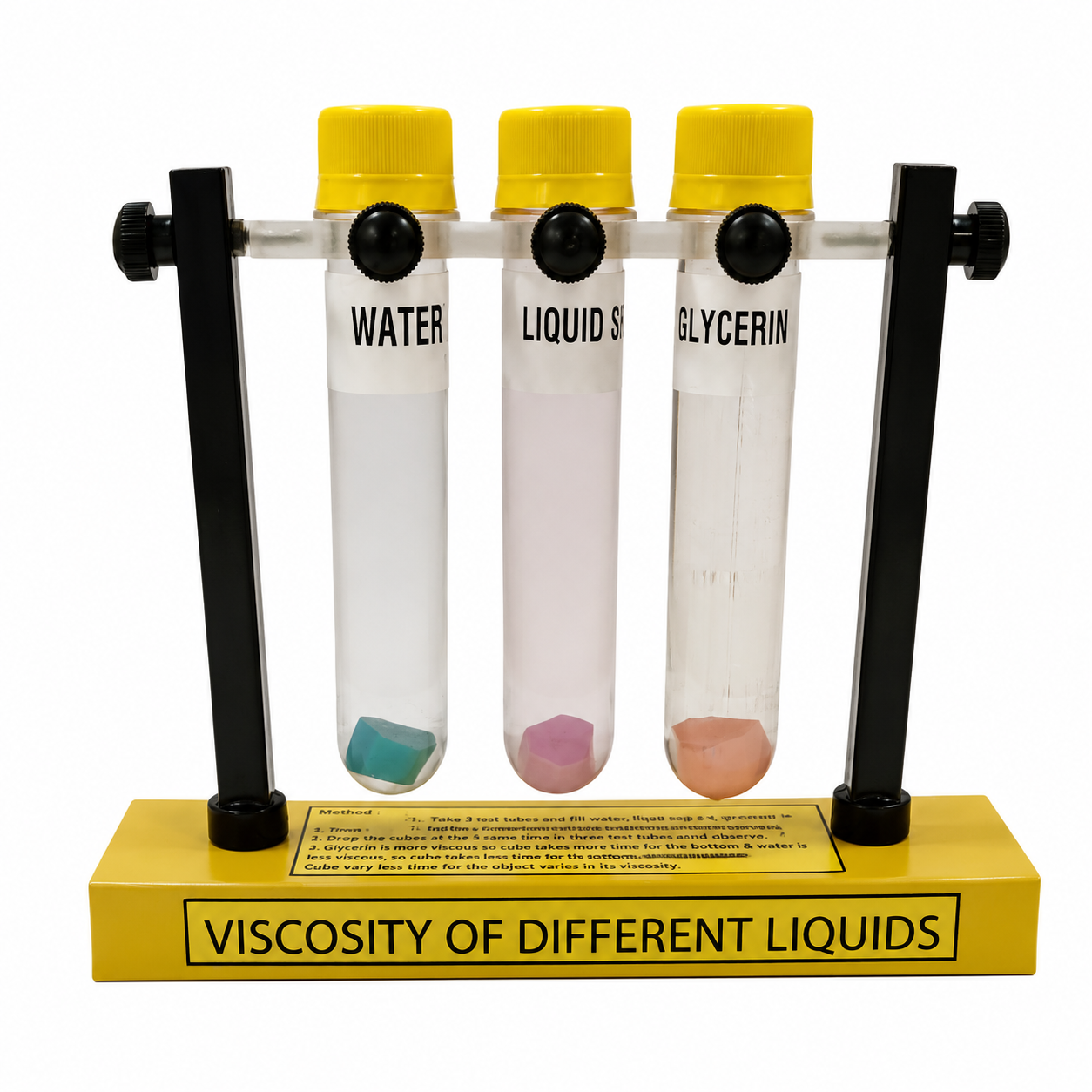
The Viscosity Tube Model by Elmo Agencies, a trusted scientific manufacturer in Ambala, is an educational demonstration apparatus designed to help students understand the concept of viscosity and resistance to motion in liquids. The set contains four transparent sealed tubes filled with different liquids, allowing learners to observe how a ball moves at different speeds through each liquid.
This hands-on model is suitable for physics classrooms, chemistry laboratories, STEM education, and science demonstrations, making the concept of fluid viscosity easier to observe and understand.
What Is a Viscosity Tube Model?
A Viscosity Tube Model demonstrates that different liquids offer different levels of resistance to an object moving through them. Each tube contains a liquid and a sealed ball. When the tube is inverted, the ball moves through the liquid.
The speed of the ball depends mainly on factors such as:
- Viscosity of the liquid
- Density difference between the ball and liquid
- Fluid resistance or drag
Generally, a more viscous liquid offers greater resistance to motion, causing the ball to move more slowly than it does through a less viscous liquid.
How Does the Viscosity Tube Model Work?
The apparatus contains four separate transparent tubes filled with different liquids, such as:
- Lamp oil
- Vegetable oil
- Water
- Corn syrup
A ball is sealed inside each tube. When students invert the tubes, they can compare the time taken by the balls to move through the different liquids.
For example, the ball may move relatively quickly through a low-viscosity liquid and more slowly through a higher-viscosity liquid. This provides a simple visual demonstration of viscosity and fluid resistance.
Set Includes
- Set of 4 transparent acrylic tubes
- Different pre-filled liquids for comparison
- One sealed ball inside each tube
- Leak-resistant sealed ends
- Ready-to-use classroom demonstration setup
Specifications
| Specification |
Details |
| Product |
Viscosity Tube Model |
| Set |
4 tubes |
| Tube Material |
Transparent acrylic |
| Demonstration |
Viscosity and resistance to motion in liquids |
| Operation |
Manual inversion of tubes |
| Ball |
Sealed inside each tube |
| Use |
Physics, chemistry, and STEM education |
| Design |
Sealed classroom demonstration apparatus |
Key Features
- 🧪 Set of four transparent demonstration tubes
- 💧 Contains different liquids for viscosity comparison
- ⚪ Sealed ball inside each tube
- 👀 Allows clear observation of different rates of motion
- 🛠️ Durable and reusable classroom design
- 🔒 Sealed construction for convenient demonstrations
- 🎓 Supports practical learning in physics and fluid science
Educational Applications
Understanding Viscosity
Demonstrates how different liquids resist the movement of an object.
Fluid Resistance and Drag
Helps students observe the resistance experienced by an object moving through a liquid.
Comparative Experiments
Students can compare the movement of balls through liquids with different flow characteristics.
Physics Education
Useful for introducing concepts related to fluids and motion.
STEM Learning
Provides a visual and interactive method for understanding basic fluid properties.
Why Choose the Viscosity Tube Model?
The Viscosity Tube Model transforms an abstract scientific concept into an easy-to-observe experiment. Instead of only studying viscosity through theory, students can directly compare how motion changes in different liquids.
Its sealed and ready-to-use design makes it suitable for:
- Classroom demonstrations
- Physics practical lessons
- Chemistry education
- STEM activities
- Science exhibitions
Ideal For
| User Group |
Application |
| Schools |
Teaching viscosity and fluid behaviour |
| Colleges |
Physics and chemistry demonstrations |
| STEM Labs |
Hands-on fluid science learning |
| Teachers |
Interactive classroom demonstrations |
| Science Exhibitions |
Visual demonstrations of fluid properties |
Frequently Asked Questions
What does the Viscosity Tube Model demonstrate?
It demonstrates how different liquids offer different levels of resistance to a moving object. Students can compare the speed of a ball moving through liquids with different viscosities.
Why does the ball move at different speeds?
Different liquids have different viscosities. More viscous liquids generally provide greater resistance to the movement of the ball.
How many tubes are included in the set?
The model consists of a set of four transparent tubes for comparing the behaviour of a ball in different liquids.
Is the Viscosity Tube Model suitable for schools?
Yes. It is suitable for school and college laboratories, STEM classrooms, and science demonstrations.
Who supplies the Viscosity Tube Model?
The Viscosity Tube Model is supplied by Elmo Agencies, a scientific manufacturer in Ambala providing educational and scientific equipment for laboratories and institutions.
Why Choose Elmo Agencies?
Elmo Agencies provides educational and scientific apparatus designed to support practical and visual learning. As a scientific manufacturer in Ambala, the company supplies science models and laboratory equipment suitable for schools, colleges, STEM laboratories, and educational institutions.
Conclusion
The Viscosity Tube Model by Elmo Agencies provides a simple and effective way to demonstrate how liquids differ in their resistance to motion. By allowing students to compare the movement of sealed balls through different liquids, the model supports practical learning of viscosity, fluid resistance, and basic fluid behaviour.