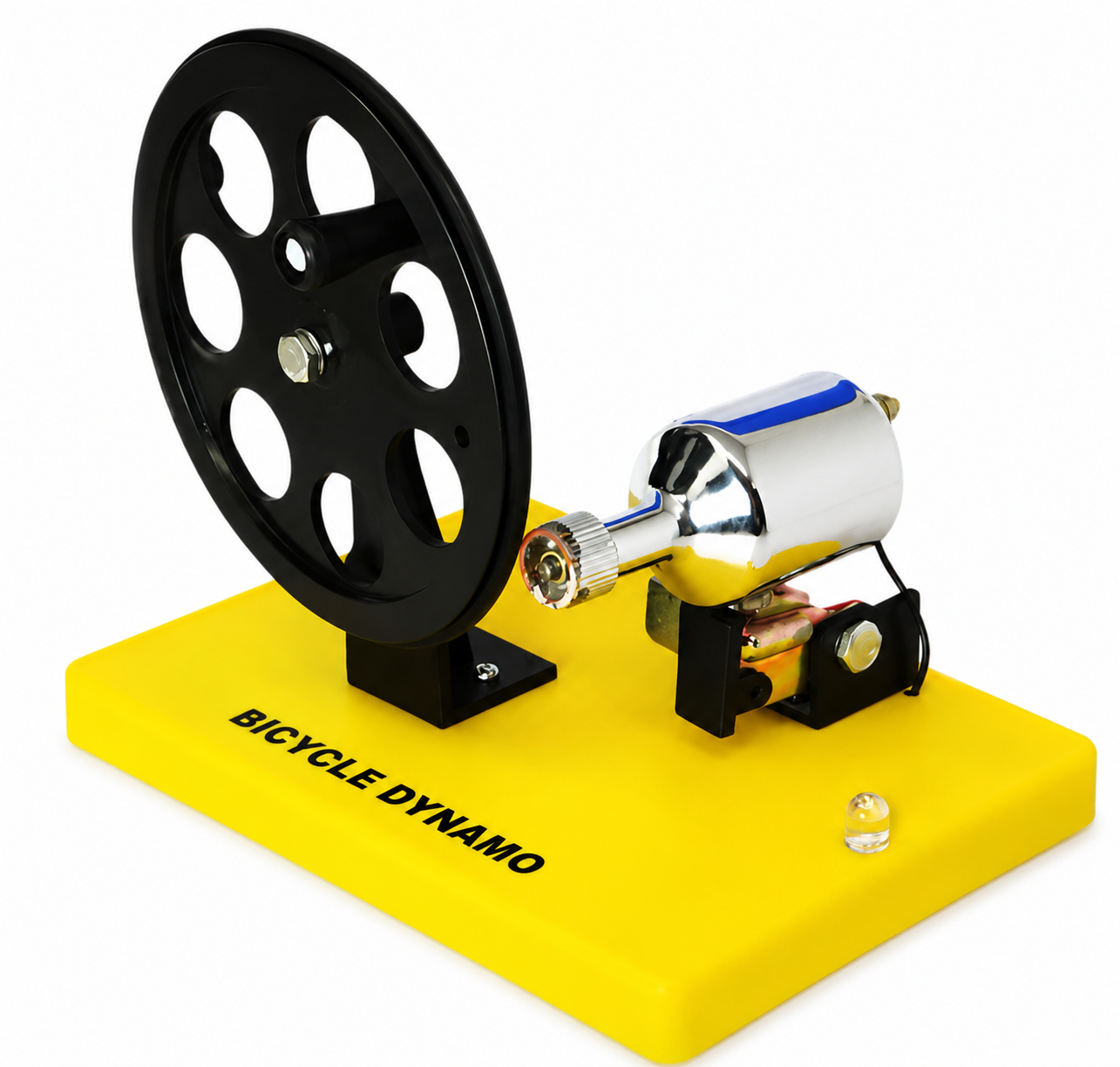
Bicycle Wheel Dynamo Model
Elmo Agencies, a scientific manufacturer in Ambala, offers the Bicycle Wheel Dynamo Model, an educational apparatus designed to demonstrate the generation of electricity through electromagnetic induction. The model helps students understand how rotational mechanical energy can be converted into electrical energy using the same fundamental principles employed in generators.
When the wheel or dynamo mechanism is rotated, a changing magnetic field relative to a coil produces an induced voltage. The electrical output can be used to operate a suitable lamp or can be observed using measuring instruments, depending on the configuration of the model.
The Bicycle Wheel Dynamo Model is suitable for physics laboratories, STEM classrooms, electrical science demonstrations and educational exhibitions.
What Is a Bicycle Wheel Dynamo Model?
A bicycle dynamo model is a simplified educational setup based on the principle of a bicycle generator.
A typical demonstration arrangement may include:
- A rotating wheel or dynamo mechanism
- A generator unit
- Permanent magnet and coil arrangement
- Output terminals
- A lamp or other electrical load
- A supporting base or frame
When mechanical rotation is supplied to the generator, the magnetic flux associated with the coil changes, inducing an electromotive force.
This demonstrates the fundamental principle of electromagnetic induction.
The exact components and construction may vary according to the specific model supplied.
Principle of Electromagnetic Induction
The Bicycle Wheel Dynamo Model demonstrates Faraday’s Law of Electromagnetic Induction.
An induced voltage is produced when the magnetic flux linked with a circuit changes.
In a bicycle generator, rotation causes relative motion between magnetic and conducting components. This changing magnetic environment induces a voltage in the coil.
In simple terms:
Mechanical rotation → Changing magnetic flux → Induced voltage → Electrical output
The amount of induced voltage depends on several factors, including:
- The rate of rotation
- Magnetic field strength
- Number of turns in the coil
- Generator construction
Increasing the rotational speed generally increases the rate at which magnetic flux changes and can increase the induced voltage.
Conversion of Mechanical Energy into Electrical Energy
One of the main educational purposes of this model is to demonstrate energy conversion.
When a student rotates the wheel or generator:
- Mechanical energy is supplied through motion.
- The generator converts part of this mechanical energy into electrical energy.
- The electrical energy can operate a connected load.
If a suitable lamp is connected, the illumination provides a visible demonstration that mechanical work is being converted into electrical energy.
Energy is not created by the dynamo. The electrical output comes from the mechanical work supplied to rotate the system.
Lenz’s Law and Mechanical Resistance
The model can also help explain Lenz’s Law.
When current is induced and supplied to a load, the resulting electromagnetic effects oppose the change that produced the current. As a result, additional mechanical effort may be required when the generator supplies electrical power to a connected load.
This provides an important demonstration of energy conservation.
For example, when a generator is connected to a larger electrical load, additional mechanical input may be required to maintain the same rotational speed.
The exact amount of resistance depends on the generator design and connected load.
How the Bicycle Dynamo Works
A bicycle generator commonly uses a permanent magnet and one or more coils.
When the rotating mechanism turns:
- Magnetic components move relative to the coils.
- The magnetic flux linked with the coils changes.
- A voltage is induced.
- Current can flow when an appropriate external circuit is connected.
This is the same fundamental principle used in many electrical generators.
Different bicycle generator designs achieve the relative motion in different ways.
Understanding AC and DC Output
A common misconception is that all bicycle dynamos directly produce DC electricity.
Many traditional bicycle dynamos and hub generators produce an alternating electrical output. The exact waveform and voltage depend on the generator design and rotational speed.
Electronic circuits can be used to:
- Rectify AC into DC
- Regulate voltage
- Supply electronic devices
- Charge suitable energy-storage systems
The Bicycle Wheel Dynamo Model can therefore support discussions about the difference between alternating current (AC) and direct current (DC), depending on the instruments and components connected to the model.
Educational Demonstration
A typical demonstration can be performed by:
- Connecting a suitable electrical load or measuring instrument.
- Rotating the wheel or dynamo mechanism.
- Observing the electrical output.
- Increasing or decreasing the rotational speed.
- Comparing changes in voltage or lamp brightness.
- Discussing the relationship between mechanical input and electrical output.
If measuring instruments are included or connected, students can investigate the electrical characteristics of the generator more quantitatively.
Educational Concepts Demonstrated
Faraday’s Law of Electromagnetic Induction
Students observe how changing magnetic flux can produce an induced voltage.
Energy Conversion
The model demonstrates the conversion of mechanical energy into electrical energy.
Lenz’s Law
A connected electrical load can increase the mechanical effort required to maintain rotation, illustrating the opposition associated with electromagnetic induction.
Conservation of Energy
The apparatus helps demonstrate that electrical energy output requires mechanical energy input.
Voltage and Rotational Speed
Students can investigate how changes in rotational speed affect the generated electrical output.
Electrical Circuits
Suitable loads can be used to discuss:
- Voltage
- Current
- Resistance
- Electrical power
AC and DC Concepts
Depending on the generator and connected equipment, students can discuss alternating and direct current systems.
Types of Bicycle Generators
Sidewall or Bottle Generator
A sidewall generator typically uses a small roller that contacts the bicycle tyre. Rotation of the tyre drives the internal generator mechanism.
This type is useful for demonstrating the relationship between wheel motion and electrical generation.
Hub Generator
A hub generator is integrated into the wheel hub. Internal magnetic and coil arrangements generate electricity as the wheel rotates.
Both systems operate using electromagnetic induction, although their mechanical construction differs.
The specific type represented in the Bicycle Wheel Dynamo Model depends on the actual product design.
Classroom Learning Applications
The Bicycle Wheel Dynamo Model can be used to support experiments involving:
1. Energy Conversion
Students observe how mechanical motion can produce usable electrical energy.
2. Electromagnetic Induction
The model provides a practical demonstration of Faraday’s principle.
3. Rotation and Voltage
Students can compare electrical output at different rotational speeds.
4. Electrical Loads
Different suitable loads can be connected to discuss electrical power requirements.
5. Generator Principles
The model introduces the basic operating principles of generators used in larger electrical power systems.
6. Motor and Generator Concepts
The model can support discussions about the relationship between electric motors and generators, although the detailed operation depends on the particular machine design.
Real-World Applications
The principles demonstrated by the Bicycle Wheel Dynamo Model are used in many technologies.
Bicycle Lighting
Bicycle generators can provide electrical power for lighting systems using the rotation of the wheel.
Electrical Power Generation
Large generators in power stations also use electromagnetic induction. Mechanical energy from turbines is converted into electrical energy through rotating electrical machines.
Wind and Water Power
Wind turbines and hydroelectric generators use mechanical motion to drive generators.
Regenerative Systems
Some electrical systems can operate machines as generators to recover energy from motion under appropriate conditions.
STEM and Renewable Energy Education
The model provides a simple introduction to sustainable energy concepts by demonstrating how human-powered mechanical motion can generate electricity.
Key Features
- Demonstrates electromagnetic induction
- Converts rotational mechanical energy into electrical energy
- Supports demonstrations of Faraday’s Law
- Helps explain Lenz’s Law and energy conservation
- Provides a visual demonstration of electrical generation
- Suitable for studying generator principles
- Supports physics and electrical science education
- Suitable for classroom and laboratory demonstrations
The exact wheel arrangement, generator type, lamp, terminals, dimensions and electrical specifications may vary according to the supplied model.
Ideal For
| Use Case |
Educational Purpose |
| Physics Laboratories |
Demonstrate electromagnetic induction |
| Electrical Science Labs |
Study basic generator principles |
| STEM Classrooms |
Connect mechanics and electricity |
| School Demonstrations |
Visualise energy conversion |
| Engineering Education |
Introduce electrical machine concepts |
| Science Exhibitions |
Demonstrate electricity generation |
| Student Projects |
Investigate voltage and rotational speed |
Frequently Asked Questions
What does the Bicycle Wheel Dynamo Model demonstrate?
It demonstrates how mechanical rotational energy can be converted into electrical energy through electromagnetic induction.
What scientific principle does the model use?
The main principle is Faraday’s Law of Electromagnetic Induction, in which a changing magnetic flux induces a voltage.
Does a bicycle dynamo produce AC or DC?
Many bicycle generators produce alternating electrical output. Some systems use electronic circuits to convert or regulate the output for DC-powered devices.
What happens when an electrical load is connected?
Supplying electrical power to a load can require additional mechanical input to maintain rotation. This helps demonstrate Lenz’s Law and conservation of energy.
Can students measure the electrical output?
A suitable voltmeter, ammeter or other measuring instrument can be used where compatible with the electrical specifications of the model.
Is this model suitable for schools?
Yes. The Bicycle Wheel Dynamo Model is suitable for demonstrations involving electromagnetic induction, electricity generation and energy conversion.
Who supplies the Bicycle Wheel Dynamo Model?
The Bicycle Wheel Dynamo Model is supplied by Elmo Agencies, a scientific manufacturer in Ambala, offering educational science apparatus and demonstration equipment.
Why Choose Elmo Agencies?
Elmo Agencies supplies educational scientific apparatus designed to support practical learning and classroom demonstrations. As a scientific manufacturer in Ambala, the company focuses on equipment that helps students connect theoretical scientific principles with observable experiments.
Conclusion
The Bicycle Wheel Dynamo Model is an effective educational apparatus for demonstrating one of the most important principles in physics and electrical science: the conversion of mechanical energy into electrical energy through electromagnetic induction.
Suitable for physics laboratories, STEM classrooms, science exhibitions and educational demonstrations, the Bicycle Wheel Dynamo Model provides a clear and engaging introduction to the science behind electrical generators.