Hand Driven Van de Graaff Generator
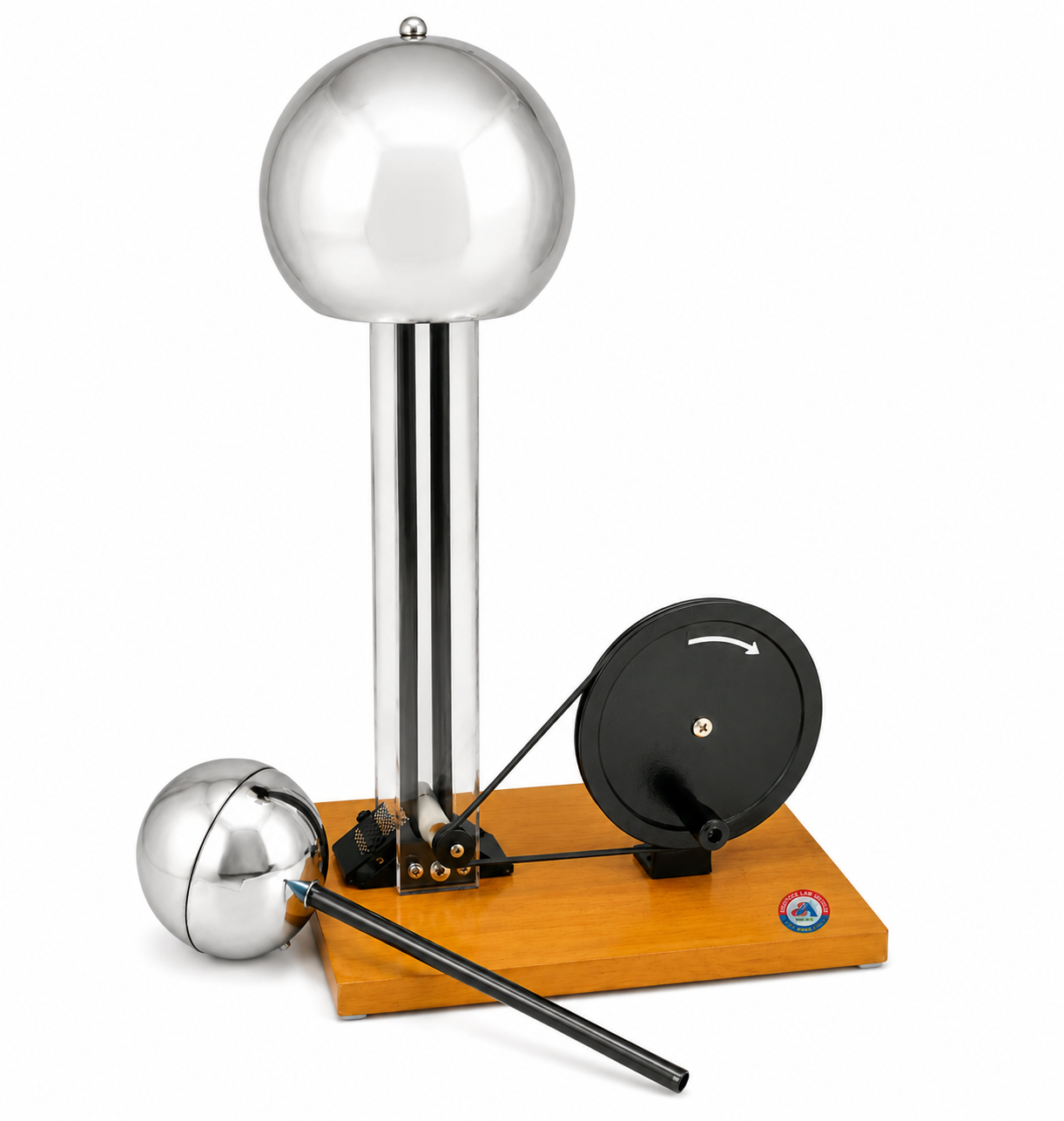
Elmo Agencies, a trusted scientific manufacturer in Ambala, offers the Hand Driven Van de Graaff Generator, an educational electrostatic apparatus designed to demonstrate the generation and accumulation of electric charge at a high electric potential.
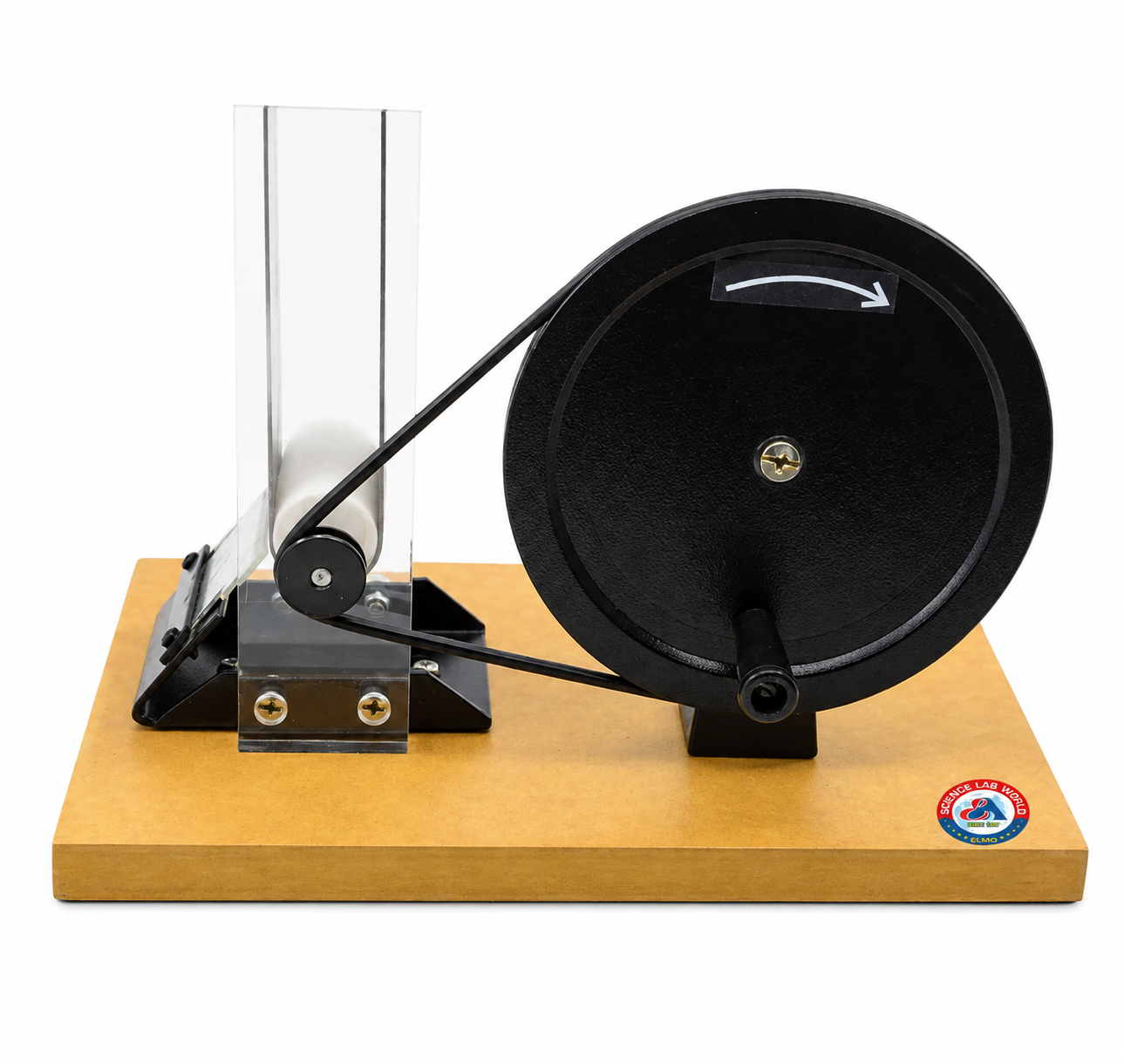
Unlike motor-driven versions, this model is operated manually using a hand-driven mechanism. Rotation moves an insulating belt inside the apparatus, allowing electric charge to be transported and accumulated on a hollow metal dome.
The apparatus provides a practical demonstration of electrostatics, electric fields, charge transfer and charge distribution. It is suitable for physics laboratories, science classrooms, STEM education and teacher demonstrations.
The generator was developed by physicist Robert J. Van de Graaff in the early twentieth century and became widely known as an important apparatus for demonstrating electrostatic phenomena.
How Does the Hand Driven Van de Graaff Generator Work?
The exact charging process depends on the materials and construction of the generator. A typical Van de Graaff generator includes:
- A hand-operated rotating mechanism
- An insulating belt
- Lower and upper rollers
- Charge-collecting combs or electrodes
- A hollow metal dome
- An insulated supporting structure
When the handle is rotated, the belt moves continuously between the lower and upper sections of the apparatus.
The belt becomes electrically charged through the charging arrangement used in the generator. Depending on the design, charge separation may involve contact electrification and the action of electric fields near the combs.
The moving belt transports charge upward toward the metal dome.
At the upper section, the charge is transferred to the conducting dome, where it spreads over the outer surface.
Continuous operation allows more charge to accumulate, increasing the electric potential of the dome.
Charge Transport and Accumulation
The moving belt acts as a charge transport system.
The process can be understood in stages:
- The hand mechanism rotates the belt.
- The charging arrangement transfers charge to the moving belt.
- The belt carries charge toward the upper terminal.
- Charge is transferred from the belt to the metal dome.
- Charge spreads across the outer surface of the conducting dome.
- Continued operation increases the electric potential until leakage or electrical discharge limits further charge accumulation.
The maximum voltage depends on several factors, including:
- Dome size
- Belt material
- Air humidity
- Cleanliness of the apparatus
- Insulation quality
- Distance from nearby objects
- Electrical leakage
- Generator design
For this reason, the voltage of a particular educational model should not be described as reaching a specific value unless that value is confirmed by the manufacturer’s specifications.
Electric Fields and Charge Distribution
The Van de Graaff Generator provides a useful demonstration of electric fields around charged objects.
When electric charge accumulates on the metal dome, an electric field exists in the surrounding space.
Because the dome is a conductor, electrostatic charge redistributes itself on the outer surface under electrostatic equilibrium.
The smooth spherical shape helps reduce sharp regions where the electric field can become highly concentrated. Sharp points can promote charge leakage through ionisation of the surrounding air.
This makes the spherical dome useful for storing a relatively large amount of charge at high electric potential.
Electrostatic Discharge
When the electric field between the charged dome and another object becomes sufficiently strong, the surrounding air can become electrically conductive.
A visible spark may then occur as charge moves through the ionised air.
The size and appearance of a spark depend on:
- Electric potential difference
- Distance between objects
- Air conditions
- Humidity
- Shape of the electrodes
- Generator design
The generator can therefore provide a visual demonstration of electrical breakdown in air.
Educational Concepts Demonstrated
Electrostatic Charge
Students can observe the accumulation of electric charge and its interaction with nearby objects.
Electric Fields
The apparatus helps demonstrate the existence and effects of electric fields around charged conductors.
Charge Distribution
The metal dome demonstrates how charge distributes itself on the surface of a conductor in electrostatic equilibrium.
Electric Potential
The accumulation of charge on the dome produces a high electric potential relative to its surroundings.
Electrical Discharge
Spark formation can be used to discuss ionisation and electrical breakdown of air.
Electrostatic Induction
The generator can be used with suitable demonstrations to investigate charge separation and induction effects.
Capacitance
The conducting dome can also support introductory discussions about capacitance and the storage of electric charge.
Possible Classroom Demonstrations
Depending on the accessories and safe operating procedures used, the Hand Driven Van de Graaff Generator can be used to demonstrate electrostatic effects such as:
- Attraction and repulsion of charged objects
- Charge transfer
- Electrostatic induction
- Electric field effects
- Discharge through air
- Charge accumulation on a conductor
Demonstrations should be performed according to the instructions supplied with the apparatus and under appropriate teacher or laboratory supervision.
Key Features
- Hand-operated electrostatic generator
- Demonstrates charge transport using a moving belt
- Hollow conducting dome for charge accumulation
- Supports demonstrations of electric fields and electrostatic effects
- Suitable for practical physics education
- Provides a visual demonstration of high electric potential
- Useful for classroom and laboratory demonstrations
The exact dimensions, dome size, belt material, charging arrangement and electrical performance depend on the specific model supplied.
Ideal For
| Use Case |
Educational Purpose |
| Physics Laboratories |
Study electrostatics and electric charge |
| School Science Classes |
Demonstrate electric field effects |
| STEM Laboratories |
Explore practical electricity concepts |
| Teacher Demonstrations |
Visualise electrostatic phenomena |
| Science Exhibitions |
Provide engaging electricity demonstrations |
| College Laboratories |
Support introductory electrostatics experiments |
Frequently Asked Questions
What does a Hand Driven Van de Graaff Generator demonstrate?
Van de Graaff Generator demonstrates the generation, transport and accumulation of electrostatic charge, along with concepts such as electric fields, electric potential and electrical discharge.
How is the generator operated?
The hand-driven mechanism rotates an insulating belt, which transports electric charge toward the upper conducting dome.
Why is the upper terminal shaped like a sphere?
A smooth conducting sphere helps distribute charge across its outer surface and reduces sharp points where electric fields can become highly concentrated and cause charge leakage.
Does the belt itself create electricity?
The belt does not create energy. The generator separates and transports electric charge through its charging mechanism, while the mechanical work supplied by the user drives the process.
Can the generator produce sparks?
Depending on the model, operating conditions and accumulated electric potential, electrostatic discharge may occur when a suitable object is brought close to the charged dome.
Does the generator always reach the same voltage?
No. The maximum electric potential depends on factors such as humidity, insulation, generator design, cleanliness and electrical leakage.
Is the Hand Driven Van de Graaff Generator suitable for schools?
Yes. It is designed as an educational apparatus for demonstrating electrostatics and related physics concepts under appropriate supervision.
Who supplies the Hand Driven Van de Graaff Generator?
The Hand Driven Van de Graaff Generator is supplied by Elmo Agencies, a scientific manufacturer in Ambala, providing educational science apparatus and physics laboratory equipment.
Why Choose Elmo Agencies?
Elmo Agencies supplies educational scientific apparatus designed to support practical learning and classroom demonstrations. As a scientific manufacturer in Ambala, the company focuses on equipment that helps students explore scientific principles through observation and hands-on experimentation.
Conclusion
The Hand Driven Van de Graaff Generator is an effective educational apparatus for demonstrating the fundamental principles of electrostatics. Its manually operated belt system transports electric charge to a conducting dome, allowing students to observe charge accumulation, electric fields, electric potential and electrostatic discharge.