-38%


Related products
-
Stem Kits, Waves & Sound
Tuning Fork Set of 8
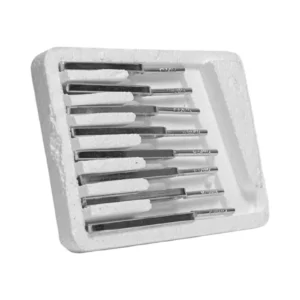
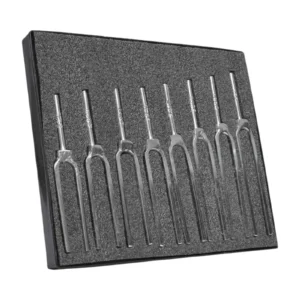
- This Tuning fork set of 8, includes 8 high-quality tuning forks, meticulously crafted for precision and durability.
- Each fork is chrome plated, ensuring a smooth finish that enhances the product’s aesthetics and lifespan.
- These tuning forks are delivered in a protective thermocol case, designed to keep each fork secure and organised, making transportation and storage convenient.
- This set offers versatility and reliability, whether for musical tuning, sound therapy, or educational purposes.
SKU: n/a -
Stem Kits, Waves & Sound
Wave Motion Apparatus – 24 Pulleys
- This Wave Motion Apparatus demonstrates the form and propagation of longitudinal and transverse waves.
- It rotates a set of cams that raise and lower 24 vertical rods with plastic highlighted tips for easy viewing.
- It measures 480mm long, is sturdy, and operates almost silently.
- Eight of the rods are positioned at 90 degrees to simulate transverse wave motion. The handle features a circular scale marked in degrees of rotation.
SKU: n/a -
Waves & Sound
Tuning Fork Set of 8 – Welch Type
- Tuning Fork Set of 8 – Welch Type Heavy is an instrument commonly used in school laboratories to generate sound for various experiments.
- This set includes eight tuning forks vibrating at specific frequencies: 426.6 Hz (A), 480 Hz (B), 384 Hz (G), 341.1 Hz (F), 256 Hz (C), 288 Hz (D), 320 Hz (E), and 512 Hz (C).
- Tuning forks are typically made from a U-shaped steel bar that produces a constant pitch when struck and comes in a velvet box.
- They demonstrate concepts such as sound waves, resonance, and vibrations, making them valuable tools in physics and music classes. By using different forks, students can explore sound properties and conduct experiments related to frequency and pitch.
SKU: n/a -
Waves & Sound
Transverse and Longitudinal Wave using Slinky
- Transverse and Longitudinal Wave using Slinky occur when the medium moves perpendicular to the wave direction, as seen by moving the Slinky up and down.
- Formed when the medium moves parallel to the wave direction, demonstrated by pushing and pulling the Slinky.
- A Slinky visually illustrates wave properties like amplitude, wavelength, and frequency.
- Slinkys help understand sound waves, which are longitudinal and demonstrate how waves propagate.
SKU: n/a -
Astronomy Lab Kits, Stem Kits, Waves & Sound
Anemometer Model
Anemometer Model Specifications
-
- Measures wind speed and Direction
- Innovative 4-cup rotor design for superior performance
- Sturdy 6-inch round base with a stylish 30 cm wide upper section
- Crafted from durable plastic for longevity
- Proudly manufactured by Elmo Agencies
SKU: n/a -