
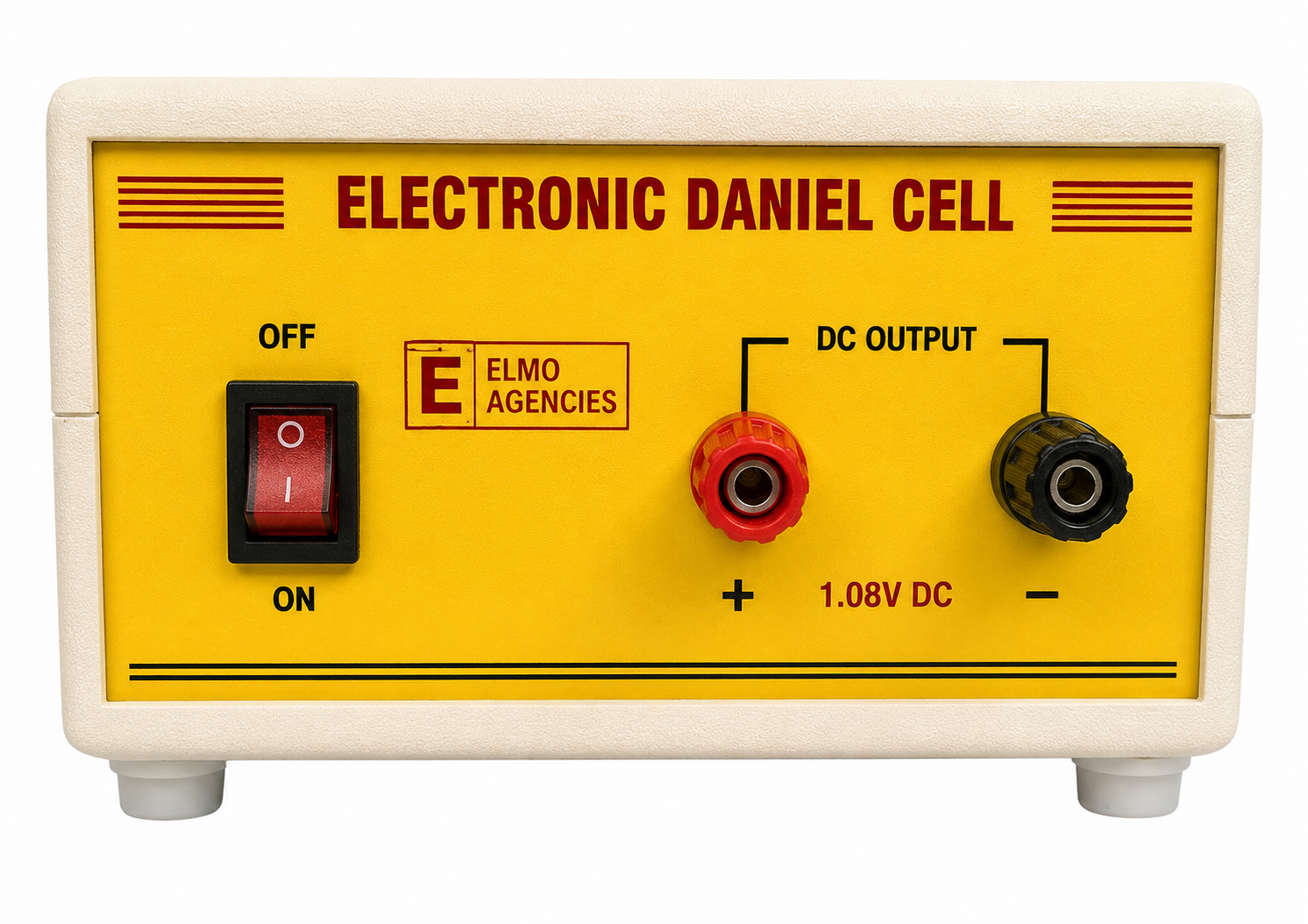
Electronic Daniel Cell
- Electronic Daniel Cell – 1.08 Volt DC Regulated.
- Input Voltage 200V AC to 240V AC Fuse 100mA.
- The output voltage is 1.08V DC and is fixed with Regulation.
- This is easy to use at all Physics Electronics Lab scientific experiments & others.
₹525.00 ₹1,000.00
- To pick up today
- Free
- More details
- More details
Electronic Daniel Cell for Galvanic Cell Demonstrations
The Electronic Daniel Cell is an educational electrochemical model designed to demonstrate the principles of electricity generation through chemical reactions. Manufactured and supplied by Elmo Agencies, a trusted scientific instrument manufacturer in Ambala, this apparatus is widely used in schools, colleges, and science laboratories for teaching electrochemistry, galvanic cells, and the fundamentals of electrical energy production.
Based on the concept developed by the renowned English chemist John Frederic Daniell, the Electronic Daniell Cell illustrates how electrical energy is generated through the interaction of different electrodes and electrolytes. It serves as an effective teaching aid for understanding oxidation, reduction, electron flow, and the conversion of chemical energy into electrical energy. The model provides students with a clear and practical demonstration of electrochemical principles that form the foundation of modern battery technology.
The Electronic Daniell Cell offers a simplified and user-friendly approach to studying electrochemical reactions. Designed for educational purposes, it allows students to observe the working principles of a Daniell Cell safely and efficiently. Through hands-on experimentation, learners gain a deeper understanding of voltage generation, electrode reactions, and the importance of electrochemical cells in scientific and industrial applications.
Manufactured using quality materials by Elmo Labs and offered by Elmo Agencies, a leading manufacturer in Ambala, the Electronic Daniell Cell is built for durability, reliability, and repeated classroom use. Its educational value and practical design make it an essential instrument for physics and chemistry laboratories, STEM education programs, and institutions focused on teaching the fundamentals of electricity and electrochemistry.
- Overview
Related products
-
Light & Optics, Physics, Physics Equipments
Glass Slab 12mm
0 out of 5(0)- Glass Slab all angles accurately worked with edges slightly bevelled
- Rectangular block made from imported optical glass
- Bubble-free glass measures 75mm long, 50mm wide, and 12mm thick
- Ideal for a variety of experiments in refraction and reflection
SKU: n/a -
General Items, Physics, Physics Equipments
Spherometer
0 out of 5(0)- A spherometer is an instrument used to measure the radius of curvature of a curved surface.
- It is a precision instrument that can measure very small distances, such as the radius of a lens.
- The spherometer consists of three legs that rest on the surface being measured.
SKU: n/a -
Desk Stand Meters, Measuring Instruments, Physics
Galvanometer
0 out of 5(0)Salient Features of the DC Moving Coil Galvanometer
- Specially designed for easy use in educational institutions and laboratories
- Meters are inclined to be easy to read and are mounted on ABS plastic stands with brass terminals.
- Multiple Ranges of Galvanometers Available – 30-0-30, 50-0-50 etc.
- Clear and well-defined dial markings with knife edge pointer
SKU: n/a -
Physics, Physics Equipments, Stem Kits, Waves & Sound
Wave Motion Apparatus – 24 Pulleys
0 out of 5(0)- This Wave Motion Apparatus demonstrates the form and propagation of longitudinal and transverse waves.
- It rotates a set of cams that raise and lower 24 vertical rods with plastic highlighted tips for easy viewing.
- It measures 480mm long, is sturdy, and operates almost silently.
- Eight of the rods are positioned at 90 degrees to simulate transverse wave motion. The handle features a circular scale marked in degrees of rotation.
SKU: n/a -
Physics, Physics Equipments, Stem Kits, Waves & Sound
Transverse and Longitudinal Wave using Slinky
0 out of 5(0)- Transverse and Longitudinal Wave using Slinky occur when the medium moves perpendicular to the wave direction, as seen by moving the Slinky up and down.
- Formed when the medium moves parallel to the wave direction, demonstrated by pushing and pulling the Slinky.
- A Slinky visually illustrates wave properties like amplitude, wavelength, and frequency.
- Slinkys help understand sound waves, which are longitudinal and demonstrate how waves propagate.
SKU: n/a
